
Affiliate disclosure: some links on this page go to Amazon. If you buy through one we may earn a small commission, at no extra cost to you. Full disclosure.
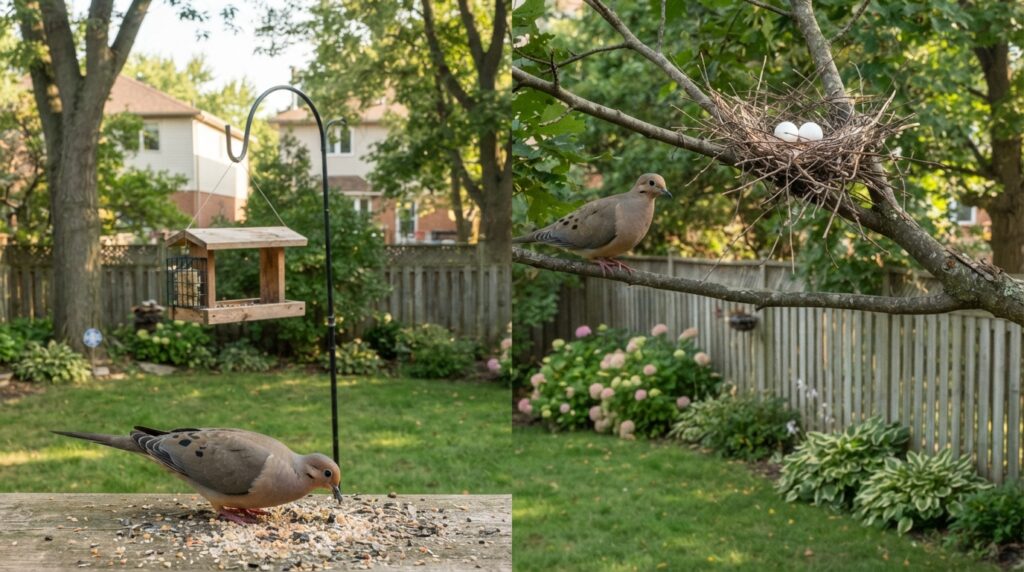
Mourning Doves feed almost entirely on the ground, so a low tray or a scattering of white proso millet and cracked corn brings them in far better than a hanging feeder. The mournful hooting is a male advertising for a mate, not a bird in distress. They build famously flimsy nests in awkward places and raise brood after brood through the season, which is how they stay one of the most abundant birds in North America despite losing a great many nests.
Mourning Doves are among the most widespread and numerous birds on the continent, present in almost every state through most of the year, and they turn up in more American yards than almost anything else. They are also routinely overlooked — treated as background, or as the thing eating spilled seed under the good feeders.
They are more interesting than that, and a few things about them catch people out every spring.
The essentials
- Ground feeders — a low tray beats a hanging feeder every time
- White proso millet and cracked corn are what they want
- The hooting is a male advertising, not grief or distress
- The whistling on takeoff is made by the wings, not the voice
- Nests are famously flimsy and often in bad places
- Both parents produce crop milk — unusual and genuinely strange
Identifying them
Slim, long-tailed, soft gray-brown, with black spots on the wings and a small head that looks slightly too small for the body. The tail is pointed and shows white edges in flight. A pale blue eye-ring and a delicate black mark below the eye are visible at close range. Males are slightly larger and show a faint pinkish wash on the breast and an iridescent patch on the neck.
Two similar birds cause confusion:
- Eurasian Collared-Dove — larger, paler, square-tailed, with a black half-collar on the back of the neck. Non-native, introduced in the 1980s, now widespread. Its call is a three-note coo rather than the Mourning Dove’s five
- Rock Pigeon — stockier, shorter-tailed, endlessly variable in color. Also non-native
In the Southwest, White-winged Doves and the tiny Inca Dove and Common Ground Dove add to the list.
The two sounds people ask about
The hooting. A soft, drawn-out coo-OO-oo-oo-oo, often mistaken for an owl and often assumed to be a bird in mourning — the name encourages it. It is a male perch-coo, advertising for a mate and announcing a territory. It is a want ad, not a lament.
The whistle. The sharp fluttering whistle when a dove takes off or lands is made by air through the wing feathers, not by the bird’s voice. Research indicates it functions as an alarm signal — a dove flushing in a hurry produces a sharper whistle, and other doves respond by taking off. A built-in alarm system that works without the bird having to do anything.
Feeding them
The single most useful fact: Mourning Doves are ground feeders with small, weak feet. They cannot cling, they struggle with small perches, and most tube feeders are effectively closed to them.
| Offer | Notes |
|---|---|
| White proso millet | The top choice. Also what juncos and native sparrows want |
| Cracked corn | Taken readily. Spoils fast and attracts rodents — small amounts only |
| Black oil sunflower | Taken from a tray; they swallow seeds whole rather than cracking them |
| Safflower | Taken, and it deters squirrels and grackles at the same time |
| Nyjer | Will take spilled nyjer from the ground under a finch feeder |
| Grit | Coarse sand or crushed eggshell. They swallow seed whole and need grit to grind it |
How to present it: a low platform tray a foot or two off the ground, or a clear patch of ground kept swept. Raised trays drain better and keep seed off wet soil. Avoid feeding directly on bare earth where it will sit and mold.
A low platform feeder with a mesh or screened base is the right tool — the mesh lets rain through so seed is not sitting in a puddle. Honest drawbacks: ground trays are the most exposed feeder there is, so squirrels, raccoons and deer all help themselves; they need cleaning more often than a tube because birds stand on the food; and seed at ground level is the main thing that draws rodents to a yard. How to manage that.
Crop milk, which is genuinely odd
Doves and pigeons do something almost no other birds do: both parents produce a nutrient-rich secretion from the lining of the crop, called crop milk, and feed it to their young for the first days of life.
It is not milk in the mammalian sense, but it serves the same function — high in protein and fat, produced by the parent’s own body. It means dove squabs do not depend on a supply of insects the way most songbird nestlings do, and that has a practical consequence: doves can breed almost year-round in warm regions, because their chick food does not depend on the season.
It also means that, unusually, the male can feed the young as completely as the female.
That nest
Mourning Dove nests are notoriously bad. A loose, flat platform of twigs, often so thin you can see the eggs through it from below, built in an ill-judged spot: a porch light, a hanging basket, a gutter, a windowsill, the top of a downspout, occasionally just on the ground.
People find them and worry. The usual questions, answered:
- Can I move it? No — and it is illegal. Mourning Doves are protected under the Migratory Bird Treaty Act, and an active nest with eggs or young cannot be moved or removed
- They picked a terrible place. They frequently do. Leave it; the cycle is short
- How long? About two weeks of incubation and roughly two weeks in the nest. Around a month start to finish, which is fast
- Can I use the porch? Try to avoid disturbance, but doves nesting on a porch have chosen to accept human traffic. Keep pets away and give them room
- Two white eggs is the normal clutch, nearly always
The flimsy nest and the poor site selection are not carelessness so much as strategy. Doves lose a lot of nests — and respond by nesting again, and again. Several broods a season is normal, and in the South they may raise five or six. Quantity over construction quality.
If you find a young dove on the ground, the usual rules apply: feathered and able to hop means fledgling, and it should be left alone. Full decision tree.
The thing most backyard feeders do not know
The Mourning Dove is a legal game bird in around forty states, and is among the most heavily hunted birds in North America — tens of millions are taken each year.
This surprises people who think of them as gentle yard birds, and it sits oddly alongside a species that is also one of the most abundant on the continent. Both things are true: the population is very large, the species is prolific, and it is managed as a game species by state and federal agencies under frameworks set with the US Fish & Wildlife Service.
A handful of states do not permit dove hunting. If it matters to you either way, your state wildlife agency publishes the current rules.
Predators and hazards
- Cooper’s and Sharp-shinned Hawks take doves regularly at feeders. A pile of gray feathers on the lawn is usually this. What to do
- Cats — ground-feeding birds are especially vulnerable. Detail
- Windows — doves flush fast and low when startled, and collide often. Prevention
- Trichomonosis, a parasitic disease that affects doves and pigeons and can pass to the hawks that eat them. Signs include lesions in the mouth and difficulty swallowing. Clean feeders and baths on schedule, and take everything down for one to two weeks if you see sick birds. Detail
Common questions
What do Mourning Doves eat?
Almost entirely seeds, taken from the ground. White proso millet, cracked corn, black oil sunflower and safflower all work. They swallow seed whole and need grit to grind it, so coarse sand or crushed eggshell helps.
Why do Mourning Doves sound so sad?
They do not feel sad. The drawn-out hooting is a male perch-coo advertising for a mate and announcing a territory. The name and the tone create the impression.
What is the whistling noise when they fly?
Air through the wing feathers, not the voice. It appears to function as an alarm — a dove flushing in alarm makes a sharper whistle, and other doves take off in response.
There is a dove nest on my porch. Can I move it?
No. Mourning Doves are protected under the Migratory Bird Treaty Act, so an active nest cannot legally be moved or removed. The whole cycle takes about a month — roughly two weeks incubating and two weeks in the nest.
How do I attract Mourning Doves?
Feed on the ground or on a low tray. White proso millet is the best single choice. They cannot use most tube feeders, so a hanging feeder alone will never bring them in.
Why do they keep nesting in bad places?
They build quickly, lose nests often, and respond by nesting again — several broods a season, more in the South. The strategy is volume rather than careful site selection or solid construction.
Related guides
- Common backyard birds of North America
- Best bird seed
- Types of bird feeders
- Nestling or fledgling? Baby bird decision tree
Sources: Cornell Lab of Ornithology, All About Birds and Birds of the World, Mourning Dove species account, including crop milk, nesting and the wing whistle; research on wing whistles as alarm signals in doves; Project FeederWatch seed preference data; US Fish & Wildlife Service and state wildlife agencies on migratory game bird management; USGS National Wildlife Health Center on trichomonosis; National Audubon Society.
Putting up a nest box?
The entrance hole diameter decides which species can use it and which cannot get in. Untreated wood, ventilation, drainage and a side that opens for cleaning are the four things to check.
This link goes to Amazon. If you buy through it we may earn a small commission, at no extra cost to you.