
Affiliate disclosure: some links on this page go to Amazon. If you buy through one we may earn a small commission, at no extra cost to you. Full disclosure.
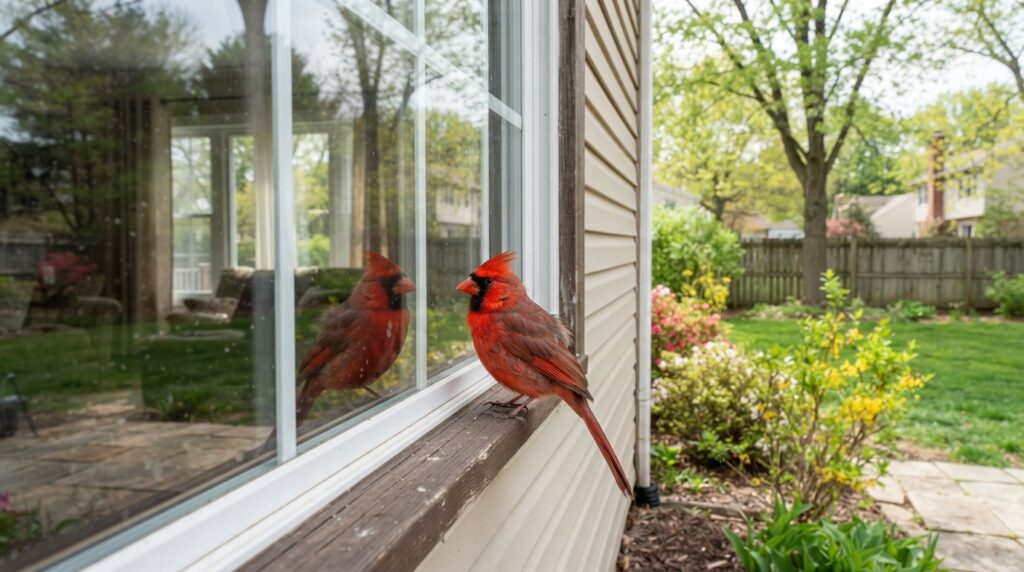
It is fighting its own reflection. In spring a territorial bird sees a rival in the glass that refuses to back down, and it keeps attacking because the rival keeps appearing. The only reliable fix is to break up the reflection on the outside of the glass — anything applied inside still leaves a mirror facing the bird. It is exhausting for the bird but rarely injures it, and it almost always stops once the breeding season settles.
This is not the same thing as a bird flying into a window and being hurt. A collision is a single hard impact by a bird that did not see the glass. This is a bird deliberately and repeatedly flying at the same pane, often from a perch a few feet away, sometimes for weeks, usually starting at first light and driving the household slowly mad.
Different problem, different cause, different fix.
What is happening
- Territorial display, not confusion or aggression toward you
- Spring behavior — peaks March through June with breeding hormones
- Males mostly, though females do it too
- Cardinals, robins and mockingbirds are the usual culprits
- The fix must go outside the glass. Blinds inside do nothing
- It stops on its own once the season passes
Why the bird cannot work it out
A male cardinal in April is defending a territory he intends to raise a brood in. Seeing off rivals is one of the most important things he does, and he is strongly motivated to do it.
When he sees his reflection, he sees an intruder that will not leave. He displays; the rival displays back identically. He flies at it; it flies at him. He drives it off; it returns the moment he lands. From his point of view, the fight never resolves, so he keeps going.
Birds do not recognize their own reflections — a capacity demonstrated in only a handful of species, and not in backyard songbirds. There is no moment of realization coming. He will keep at it until the hormonal drive fades or the reflection stops appearing.
The same behavior shows up at car mirrors, chrome bumpers, hubcaps, patio doors, greenhouse panes and shiny grills. Anything that reflects.
Which birds do it
| Species | Notes |
|---|---|
| Northern Cardinal | The classic. Highly territorial, conspicuous, and starts very early in the morning |
| American Robin | Common, and often the messiest — leaves droppings and smears down the glass |
| Northern Mockingbird | Ferociously territorial and persistent |
| Eastern and Western Bluebird | Frequently at car mirrors |
| American Goldfinch, House Finch | Less often, usually briefer |
| Ruby-throated Hummingbird | Occasionally, at reflective surfaces near feeders |
| Wild Turkey | Yes, really. At car panels, and startling at close range |
Is the bird hurting itself?
Usually not seriously. These are deliberate approaches from a short distance rather than full-speed collisions, and birds rarely injure themselves badly against a pane they are attacking on purpose.
The real cost is energy. A bird spending hours a day fighting a reflection is not feeding, not defending its actual territory, and not helping raise its brood. Over weeks, in the most demanding season of its year, that adds up.
So it is worth stopping — for the bird as much as for your sanity.
If the bird is striking hard enough to leave dust marks on the glass, or if you find it stunned on the ground, treat it as a collision rather than a territorial display. A stunned bird should be left alone somewhere quiet and safe to recover; one that is bleeding, cannot fly after an hour, or has been near a cat needs a licensed wildlife rehabilitator. Full guidance on window collisions.
The fix: break the reflection from outside
This is the single most important point on the page and the reason most attempts fail.
Closing blinds or curtains inside does nothing. Reflection happens on the outer surface of the glass and depends on it being brighter outside than in. Making the room darker makes the reflection stronger. Taping paper to the inside of the window has the same problem.
Whatever you use has to go on the outside.
What works
- Soap or window chalk on the outside, scribbled across the pane. Free, immediate, and washes off. The least elegant and most effective thing on this list
- Tempera paint in a loose pattern — same idea, lasts longer in rain
- External screens or netting mounted a few inches off the glass. Also stops genuine collisions
- Decals, tape strips or cords applied outside, spaced no more than two inches apart. Sparse decals do not work — the bird simply attacks the gaps
- Non-reflective film applied outside, which is the tidiest permanent option
- Cardboard or a sheet taped outside for a week or two while the drive passes
If you buy decals, buy enough to cover the whole pane at roughly two-inch spacing and confirm the product is rated for external application — many are sold for interior use and will not help with either problem. Honest drawbacks: a properly treated window is visibly patterned from inside, adhesive lifts and yellows after a few years of sun, and ultraviolet-only products marketed as invisible to people have produced mixed results in independent testing.
Car mirrors and bumpers
- Cover the mirrors with a plastic bag or sock when parked
- Fold mirrors in flat against the car
- Park somewhere different for a couple of weeks, or under cover
- A cardboard flap taped over a bumper or grill works as well as anything
What does not work
| Attempt | Why not |
|---|---|
| Blinds or curtains inside | Makes the reflection stronger, not weaker |
| A single hawk silhouette decal | Birds attack around it. Spacing is what matters, not the shape |
| Plastic owls | Birds habituate within days |
| Hanging CDs or foil strips | More reflective surfaces. Sometimes makes it worse |
| Ultrasonic deterrents | No credible evidence they affect birds |
| Scaring the bird off each time | It returns within minutes, and you will lose |
| Trapping or removing the bird | Illegal for native species under the Migratory Bird Treaty Act |
How long it lasts
Most cases run a few weeks and stop, usually by early summer once territories are settled and birds are busy with nestlings. Some individuals persist through a whole breeding season, and a few come back the following spring to the same window.
Treat the glass for two or three weeks and the habit usually breaks even after you remove the treatment, because the bird stops associating that spot with a rival.
A genuinely useful side effect. Whatever you apply outside to stop the attacks also reduces the risk of real window collisions, which kill an estimated hundreds of millions of birds a year in the United States, with a large share at ordinary homes rather than tall buildings. If one window is worth treating for a noisy cardinal, the others may be worth treating for the birds you never see hit them. More on that.
Common questions
Why does a cardinal keep hitting my window?
It sees its own reflection and reads it as a rival male on its territory. It attacks, the reflection attacks back identically, and the fight never resolves — so it keeps going.
Will closing the blinds stop it?
No, and it can make things worse. Reflection depends on the outside being brighter than the inside, so darkening the room strengthens it. The fix has to be applied to the outside of the glass.
Is the bird injuring itself?
Rarely seriously — these are deliberate short-range attacks, not high-speed collisions. The real cost is wasted energy during the most demanding season of the bird’s year, which is why it is worth stopping.
How long will it go on?
Usually a few weeks, ending by early summer as territories settle. Some birds persist all season, and some return to the same window the following spring.
What is the cheapest thing that actually works?
Soap or window chalk scribbled on the outside of the pane. Free, immediate, washes off, and more effective than most products sold for the purpose.
Can I move the bird somewhere else?
No. Native birds are protected under the Migratory Bird Treaty Act, and trapping or relocating one is illegal without permits. Treat the glass instead.
Related guides
- Why birds fly into windows and how to stop it
- Northern Cardinal: how to attract them
- Best window bird feeders
- Spring migration in the yard
Sources: Cornell Lab of Ornithology, All About Birds, on birds attacking windows and territorial reflection behavior; American Bird Conservancy on external window treatments and spacing; Project FeederWatch; National Audubon Society; US Fish & Wildlife Service, Migratory Bird Treaty Act; published estimates of US window collision mortality (Loss et al.).
Want a closer look?
A pair of 8x42 binoculars is the single thing that changes backyard birding most. Close focus matters more than magnification when the bird is fifteen feet away.
This link goes to Amazon. If you buy through it we may earn a small commission, at no extra cost to you.