
Affiliate disclosure: some links on this page go to Amazon. If you buy through one we may earn a small commission, at no extra cost to you. Full disclosure.
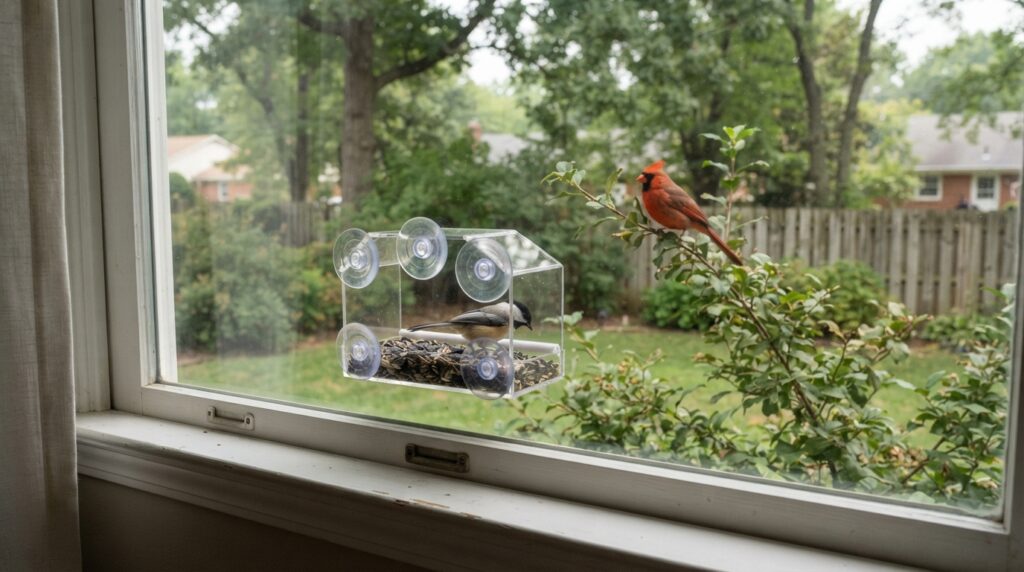
Window feeders give the closest views of any feeder and, mounted on the glass, the lowest collision risk — a bird cannot build up enough speed to hurt itself. What decides whether you are happy with one is the suction cups: clean glass, warm application and periodic re-seating are what keep it up. They hold little seed and get messy, so they suit close viewing and filming rather than being your main feeder.
A window feeder is the cheapest way to get a wild bird to within a foot of your face, and it is the setup most people mean when they say they want to film birds. It is also widely misunderstood as dangerous, when correctly placed it is the opposite.
What matters
- Suction cups decide everything. Most failures are dirty glass or cold weather
- Lowest collision risk of any placement, not the highest
- Small capacity — a supplement or a viewing feeder, not your main one
- Easy to clean, and it needs it often
- Great for filming, with a couple of tricks for shooting through glass
- One-way film on the glass lets you watch without spooking them
Why they are safe, not dangerous
The common worry is that a feeder on a window invites collisions. The opposite is true, and it is worth understanding why.
Window collisions are dangerous when a bird has room to accelerate — roughly three to thirty feet from the glass. A feeder mounted directly on the window sits inside that distance, so a bird leaving it simply cannot build up enough speed to injure itself. Cornell Lab’s guidance reflects this: feeders on the glass, or within three feet of it, are among the safest placements there is.
The genuinely dangerous spot is a free-standing feeder in the middle distance. If you have one of those, moving it onto the window is a safety improvement. Full detail on window strikes.
Suction cups are the whole game
Nearly every complaint about window feeders comes down to the feeder falling off. It is almost always avoidable.
Making suction cups hold
- Clean the glass first with glass cleaner or vinegar, then dry it. Grease and dust are what break the seal
- Clean the cups too — a wipe with rubbing alcohol
- Warm them slightly before pressing on. Warm rubber conforms to the glass; cold rubber does not
- Press firmly and give a small twist to push air out
- Re-seat periodically. Suction weakens over weeks. Check it before it fails
- A dab of water on the cup improves the seal on application
Cold weather is the real enemy. Suction cups lose grip as they stiffen in the cold, and a feeder full of seed and snow is heavier than the cups were holding in September. In hard winter, check the seal often, re-warm and re-seat the cups on a mild day, and do not overfill. A feeder that falls in January takes the seed and often a cracked dish with it.
What to look for
| Feature | Why |
|---|---|
| Strong, large suction cups | The single most important feature. More and bigger is better |
| Light weight | A heavy feeder strains the cups, especially full |
| Removable seed tray | You will clean it constantly. A tray that slides out is worth a lot |
| Drainage holes | Rain collects in the tray otherwise |
| A roof or overhang | Keeps seed dry and cups shaded |
| Clear acrylic | Lets you watch and film through the back of the feeder as well as the side |
Look for the largest suction cups you can find and a design that comes apart for cleaning. Honest drawbacks across the whole category: small capacity means daily refills in a busy yard, the outside of the glass gets streaked with droppings and seed dust, suction cups fail eventually and in cold weather sooner, and larger birds — cardinals, jays, doves — mostly cannot use them. This is a viewing feeder, not a workhorse.
Which birds will use it
The clinging, perching birds take to window feeders readily: chickadees, titmice, House Finches, nuthatches, goldfinches, and Downy Woodpeckers. They are bold about it once they accept the feeder.
Larger and more cautious birds are less likely. Cardinals occasionally use a window platform but generally prefer to stand further from the house. Ground feeders will not use one at all.
Acceptance can take longer than a yard feeder, because a feeder flat against a house with movement visible behind the glass reads as riskier. Starting with the blind partly drawn, then opening it gradually as birds settle, helps.
Filming through the glass
The main reason people buy these, and there are a few tricks that make the difference between usable footage and a reflection of your living room.
- Get the lens close to the glass, almost touching. This is the single biggest fix — it eliminates most reflections
- Shoot with the room darker than outside. A bright room behind you reflects in the glass. Turn lights off, or drape something dark behind the camera
- Clean both sides of the glass. The outside gathers seed dust and droppings fast, and the camera sees every speck
- A lens hood or a dark cloth around the lens pressed to the glass kills side reflections
- A polarizing filter cuts glare, at the cost of some light
- Focus on the bird, not the glass. Autofocus sometimes grabs the smeared surface — switch to manual if it hunts
One-way window film applied to the glass lets you watch and film from inside without the birds seeing movement behind the pane, which makes them far more relaxed and much closer. It is cheap, removable, and one of the better upgrades for a window-feeder setup. It does darken the room slightly.
Camera feeders vs a window feeder plus your phone
Worth weighing, because they solve overlapping problems.
A camera feeder records when you are not there and identifies species automatically, at the cost of a higher price, a possible subscription, and dependence on wifi reaching the yard.
A window feeder plus a phone on a small tripod gives you the closest possible view when you are there, for a fraction of the cost and with no subscription. It does not record while you are out, and it does not identify anything for you.
If you mainly want to watch and film while you are home, the window feeder is the better value by a wide margin. If you want footage of what visits while you are at work, the camera feeder is the tool. Some people run both, on different windows.
Cleaning
Window feeders need cleaning at least as often as any other feeder — every two weeks minimum, weekly in heavy use — and the glass around them needs wiping more often than that. Because they are right at eye level, a dirty one is very visible.
The advantage is that they are among the easiest feeders to clean: unclip, take to the sink, wash, dry, re-seat. Do not refill a damp tray, which molds fast. Full method.
Common questions
Do window bird feeders cause birds to hit the glass?
No — mounted on the window they reduce the risk, because a bird leaving them cannot accelerate enough to be hurt. The dangerous zone is three to thirty feet from the glass.
Why does my window feeder keep falling off?
Almost always dirty glass, dirty cups, or cold weather stiffening the rubber. Clean both surfaces, warm the cups before pressing them on, and re-seat them every few weeks before the seal fails.
Do window feeders work in winter?
Yes, but suction cups lose grip in the cold and a snow-laden feeder is heavier. Check the seal often, re-warm and re-seat on a mild day, and do not overfill.
How do I film birds through the window without reflections?
Get the lens right up to the glass, keep the room darker than outside, clean both sides of the glass, and shade the lens with a hood or dark cloth. One-way window film helps a lot.
Which birds use window feeders?
Chickadees, titmice, House Finches, nuthatches, goldfinches and Downy Woodpeckers readily. Cardinals sometimes. Larger and ground-feeding birds mostly will not.
Is a window feeder or a camera feeder better?
A window feeder gives the closest view while you are home, cheaply and with no subscription. A camera feeder records while you are out and identifies species. Different jobs — some people use both.
Related guides
- Why birds fly into windows
- Bird feeder cameras
- Bird feeders for a balcony or apartment deck
- Types of bird feeders
Sources: Cornell Lab of Ornithology, All About Birds, on window feeders, feeder placement and collision distance; Project FeederWatch, Feeding Birds, on feeder cleaning; American Bird Conservancy on window collision distances; manufacturer specifications for window-mount feeders.
Starting out?
One tube feeder with black oil sunflower brings in more species than any other single setup. Metal ports last; all-plastic ports get chewed open within a season or two.
This link goes to Amazon. If you buy through it we may earn a small commission, at no extra cost to you.