
Affiliate disclosure: some links on this page go to Amazon. If you buy through one we may earn a small commission, at no extra cost to you. Full disclosure.
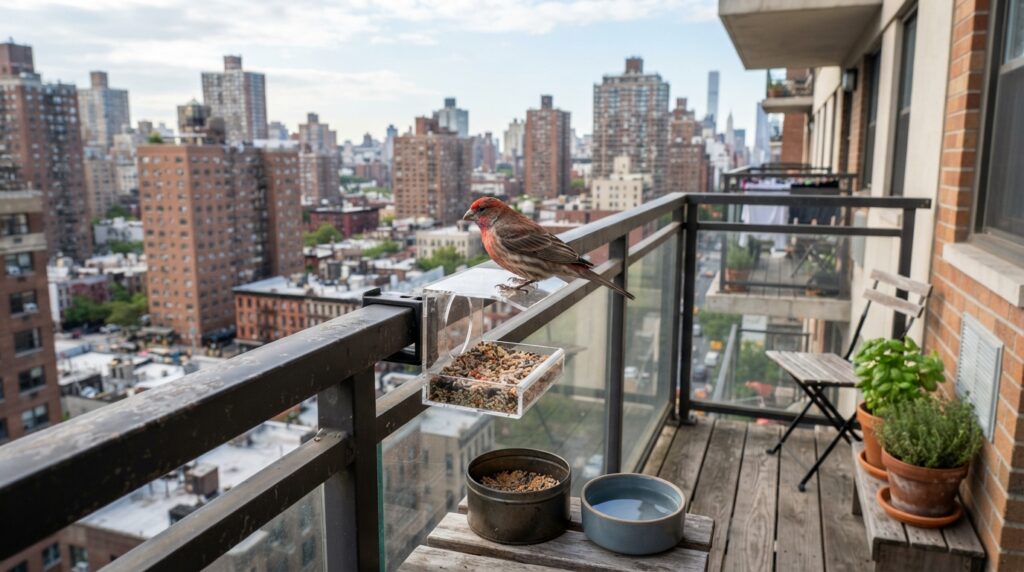
A window feeder or a railing-mounted tray with a seed catcher works well on a balcony, and hummingbird feeders work particularly well because they make no mess at all. Two things decide whether it goes smoothly: containing the debris so nothing lands on the neighbor below, and checking your lease or HOA rules first, because a fair number of them prohibit feeding.
Not having a yard is not a reason to skip this. Balconies get chickadees, House Finches, doves and hummingbirds routinely, and a fourth-floor railing is closer to eye level with birds than most backyards ever get.
The constraints are genuinely different though: no ground to rake, someone living directly underneath, and often a written rule about what you can hang off the railing.
What matters on a balcony
- Check the rules first — lease, HOA or condo bylaws
- Contain the mess. There is no lawn, only a neighbor’s balcony
- No-waste food avoids most of the problem outright
- Nothing that can fall — secure fixings, not hooks that lift off
- Small capacity, because seed goes stale before it gets eaten
- Hummingbird feeders are the easiest option by a distance
Check the rules first
Plenty of leases, HOAs and condo associations prohibit feeding birds or wildlife, or restrict what may be attached to a balcony railing. The usual reasons are droppings, seed attracting rodents, and things falling on people below — all reasonable, and all avoidable.
Look for wording about “feeding wildlife”, “attachments to railings”, “items visible from the exterior”, or balcony use generally. Where feeding is restricted, hummingbird feeders are sometimes treated differently since they produce no seed and no hulls. It is worth asking specifically rather than assuming either way.
Some cities also have ordinances on feeding wildlife, usually aimed at pigeons and waterfowl. Worth a quick check if you are in a dense urban area.
What works on a balcony
Window feeders
A tray or small tube attached to the glass with suction cups. The best option for close viewing there is — birds a foot from your face — and it keeps everything on your side of the railing.
Collision risk is low here, which surprises people. A bird leaving a feeder attached to the glass cannot build up enough speed to injure itself; the dangerous distance is roughly three to thirty feet away.
Drawbacks: small capacity, suction cups fail in cold weather and need cleaning and re-wetting periodically, and the outside of the window gets messy. Larger birds cannot use them.
Railing-mounted trays and hoppers
Clamp or bolt to the railing itself. More capacity than a window feeder and they suit a wider range of birds.
What to look for: a clamp that positively grips rather than a hook that rests, a mesh or screened base for drainage, a lip deep enough to keep seed from blowing off, and a roof if you can get one.
Drawbacks: the most exposed option, so cleaning is frequent, and this is where debris management matters most.
Hummingbird feeders
The easiest balcony option and the one that solves the mess problem entirely. No seed, no hulls, nothing to fall. Hummingbirds are also perfectly willing to visit upper-floor balconies, particularly with a few tubular flowers in a pot alongside.
A window-mounted saucer feeder combines both advantages: no mess and the closest view you will ever get of a hummingbird. Honest drawbacks: small capacity means refilling often, nectar still needs changing every two days above 90°F regardless of level, and suction cups on a sun-facing window lose grip in heat. Check the mount is rated for the weight when full.
Containing the mess
The single thing that determines whether balcony feeding causes a problem.
| Method | Effect |
|---|---|
| Sunflower chips instead of whole seed | No hulls at all. The most effective single change |
| Hulled or no-mess mixes | Same principle, sold ready made |
| A seed catcher tray under the feeder | Catches what gets dropped |
| Feeder set inboard of the railing | Debris lands on your balcony, not below |
| Sweeping daily | Unglamorous and necessary |
| Filling small | Less to spill, and it does not go stale |
Hulled seed costs noticeably more per pound and spoils faster once wet, so store it sealed and buy smaller quantities. In a balcony setting it is usually still the right trade, because the alternative is hulls on somebody else’s furniture.
Safety
- Nothing that can fall. A feeder dropping several floors is a serious matter. Use clamps and bolts, not S-hooks that can lift off in wind
- Check fixings monthly, and after storms
- Do not lean out over the railing to refill. Choose a feeder you can reach comfortably from a standing position
- Wind matters more up high. Lightweight feeders swing, spill and eventually break loose
What to expect
Balcony feeding attracts a narrower range than a yard, and that is worth knowing before you are disappointed.
Likely: House Finches, House Sparrows, chickadees, titmice, Mourning Doves, hummingbirds, and in some regions Lesser Goldfinches.
Unlikely: ground feeders like juncos and towhees, woodpeckers, and most species that want cover close by.
Height helps rather than hurts — higher balconies often do better, because birds move at that level between trees and rooftops. A few potted plants make a substantial difference, giving birds somewhere to pause before committing.
Cleaning
Balcony feeders need cleaning at least as often as yard feeders and usually more, because everything is concentrated in a small space and there is no ground for debris to disperse into.
Every two weeks minimum for seed feeders, weekly for trays, and hummingbird nectar every two to five days depending on temperature. Take the feeder to a sink rather than rinsing it over the railing. Full method here.
Common questions
Can I feed birds from an apartment balcony?
Usually, but check your lease or HOA rules first — a fair number restrict feeding wildlife or attachments to railings. Window and railing feeders both work well where it is permitted.
How do I stop seed falling on the balcony below?
Use sunflower chips or a no-mess hulled mix so there are no shells, add a seed catcher tray, and set the feeder inboard of the railing rather than overhanging it.
Will birds find a feeder on the fourth floor?
Yes. Height is not the obstacle people expect — birds move between trees and rooftops at that level. A couple of potted plants nearby speeds it up considerably.
Are window feeders dangerous for birds?
No. Correctly placed they reduce collision risk, because a bird leaving a feeder on the glass cannot accelerate enough to hurt itself. The risky distance is three to thirty feet from a window.
Which is best if I want the least mess?
A hummingbird feeder. No seed, no hulls, nothing to fall, and it often sits outside feeding restrictions that are aimed at seed. Second choice is a window feeder with sunflower chips.
Will it attract rodents?
Spilled seed can, particularly at ground level below. Containing debris and sweeping daily deals with it. More on rodents here.
Related guides
- Types of bird feeders
- Best hummingbird feeders
- Why birds fly into windows
- Mice and rats under the bird feeder
Sources: Cornell Lab of Ornithology, All About Birds, on feeder placement, window feeders and collision distance; Project FeederWatch, Feeding Birds; National Audubon Society; manufacturer specifications for window-mount and railing-mount feeders.
Lease, HOA and municipal rules vary. This page is general information — check your own agreement and local ordinances before setting up.
Starting out?
One tube feeder with black oil sunflower brings in more species than any other single setup. Metal ports last; all-plastic ports get chewed open within a season or two.
This link goes to Amazon. If you buy through it we may earn a small commission, at no extra cost to you.