
Affiliate disclosure: some links on this page go to Amazon. If you buy through one we may earn a small commission, at no extra cost to you. Full disclosure.
Seed that got rained on today and is only damp can be spread out to dry completely and used. Seed that is clumped, has a dusty gray or greenish bloom, smells musty, feels slimy, or has sprouted should be thrown away. Moldy seed causes aspergillosis, a fungal lung infection that is usually fatal, and it is not worth the saving.
This comes up after every heavy rain, and after every winter when someone finds a half-used sack in the garage. The instinct to salvage it is reasonable — seed is not cheap and throwing away most of a bag feels wasteful.
The line is not really about how wet it is. It is about whether mold has started.
Keep or bin
- Damp from today’s rain, still loose, smells of nothing → dry it, use it
- Clumped together in lumps → bin it
- Dusty gray, white or greenish film → bin it
- Musty, sour or fermented smell → bin it
- Slimy or sticky to the touch → bin it
- Sprouting → bin it
- Any doubt at all → bin it
Why moldy seed matters
Two separate problems, and both are serious.
Aspergillosis is a fungal infection of the respiratory tract, caused by birds inhaling spores from moldy seed or damp debris. Signs include labored breathing, lethargy and weight loss, and it is frequently fatal. Unlike the bacterial diseases at feeders, it does not spread bird to bird — every affected bird breathed in spores from somewhere, and a moldy feeder is a very plausible somewhere.
Aflatoxin is a toxin produced by Aspergillus molds, and it is most associated with corn and peanuts. It is harmful in small quantities and is not something a bird recovers from by eating better later.
Neither of these is a theoretical risk that applies to somebody else’s yard. Both come from exactly the situation this article is about.
Drying seed that is only damp
If it got rained on today, is still loose and free-running, and smells of nothing much:
- Spread it in a single thin layer on a tray, tarp or sheet of cardboard
- Somewhere with moving air — a garage with the door open, a covered porch, direct sun if you have it
- Stir it every few hours
- Leave it until it is completely dry and running freely again
- Smell it once more before it goes anywhere near a feeder
Do not try this in a damp shed with no airflow, and do not put it back in a sealed container while there is any moisture left — that is precisely how mold gets started.
Do not dry seed in an oven or microwave. It is occasionally suggested online. Heat damages the oils that make sunflower worth eating, it does not remove aflatoxin, and it will not undo mold that has already begun.
Seed in the feeder itself
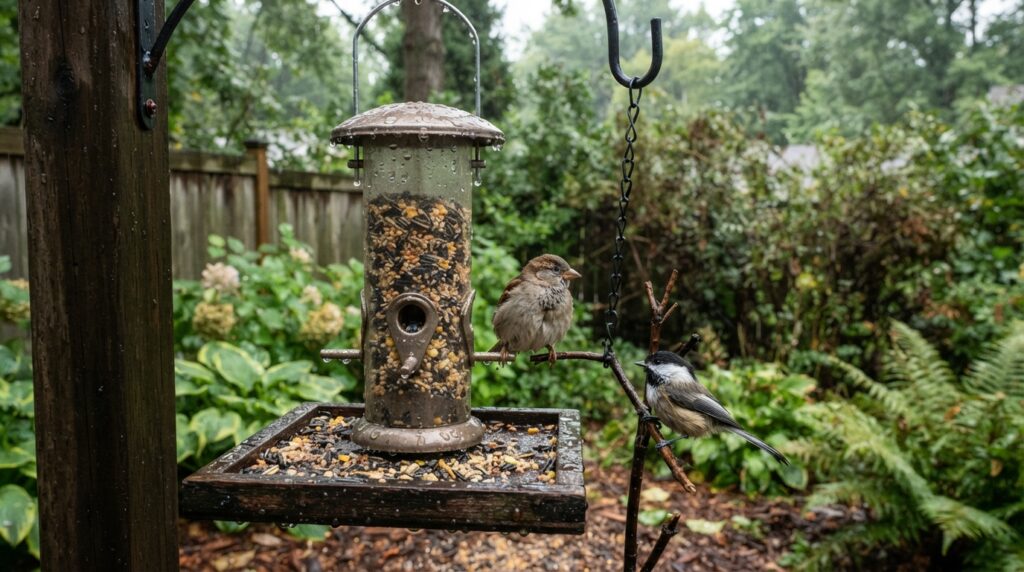
The part people forget. Rain runs into tube feeders through the ports, and the column of seed below the lowest port never gets eaten, so it sits there indefinitely.
That bottom inch or two is where mold starts in almost every tube feeder, and topping the feeder up over it just buries the problem deeper.
- At every cleaning, empty the feeder completely rather than topping up
- Dry it fully before refilling — several hours for a tube
- Fill with what will be eaten in a few days rather than to the brim
- Check that drainage holes in trays and platforms are actually clear
- Rake up spilled seed underneath. Wet hulls on the ground are their own mold problem, and ground-feeding birds work through them
Full method in how to clean bird feeders.
Storage: how to stop it happening
Most spoiled seed spoils in storage rather than in the feeder.
| Do | Don’t |
|---|---|
| A sealed metal container with a tight lid | The paper or plastic sack it came in |
| Somewhere cool, dry and shaded | A hot garage, a damp shed, direct sun |
| Raised off a concrete floor | Sitting on concrete, which sweats |
| Quantities you will use in a month or two | The largest sack available |
| Older seed used first | New seed tipped on top of old |
Metal rather than plastic matters if there is any chance of rodents, because they chew through plastic bins without much difficulty. A galvanized trash can with a fitted lid is the traditional answer and still a good one.
Check the stated capacity against the sack size you actually buy — the common annoyance is a container that a 20 lb bag does not quite fit into. Honest drawbacks: metal containers are heavier and more awkward to move than plastic, they can rust from the inside if seed goes in damp, and the lids on cheaper ones do not seal tightly enough to keep humidity out in a coastal or southern climate.
How long seed keeps
| Seed | Stored properly |
|---|---|
| Black oil sunflower | Several months |
| Safflower | Several months |
| Sunflower chips | Shorter — no shell to protect the kernel |
| White proso millet | Several months |
| Peanuts | Shorter. Highest aflatoxin risk |
| Cracked corn | Shortest. Spoils fast, high aflatoxin risk |
| Nyjer | Weeks. Dries out and is then refused outright |
| Suet (plain) | Turns rancid above about 90°F |
Nyjer is the one that catches people out. It does not go visibly moldy — it just dries out, loses its oil and stops being attractive. Fresh nyjer feels slightly oily; stale nyjer is dry and dusty. Finches will simply stop using the feeder, and it is the commonest reason a goldfinch feeder goes quiet. More on that here.
Handling seed you are throwing out
- Bag it and put it in the trash. Do not tip it on the ground, on a compost heap, or in a corner of the yard — birds will find it
- Wear gloves, and avoid breathing the dust. Aspergillus spores affect people too, particularly anyone with a respiratory condition or a suppressed immune system
- Do it outdoors, not over a kitchen bin
- Clean and disinfect the container before refilling it
Common questions
Can birds eat wet bird seed?
Seed that is merely damp from today’s rain can be dried thoroughly and used. Once it has clumped, developed a bloom, smells musty or has sprouted, mold has started and it should be thrown away.
What does moldy bird seed do to birds?
It causes aspergillosis, a fungal infection of the respiratory tract that is often fatal. Corn and peanuts additionally carry a risk of aflatoxin, a toxin produced by the same group of molds.
Is last year’s bird seed still good?
Possibly, if it was sealed, cool and dry. Smell it and feel it — fresh sunflower is faintly nutty and slightly oily. Musty, dusty or clumped means bin it. Nyjer from last season is almost certainly finished.
Can I dry seed in the oven?
No. Heat damages the oils that make seed worth eating, does not remove aflatoxin, and cannot reverse mold that has already begun. Air drying in a thin layer is the only sensible method.
Why does the seed at the bottom of my tube feeder go bad?
Seed below the lowest port never gets eaten, so it sits there while rain works in through the ports. Empty the feeder completely at each cleaning rather than topping up over it.
Is moldy seed a risk to me?
Aspergillus spores can affect people, particularly anyone with a respiratory condition or reduced immunity. Wear gloves, handle it outdoors, and avoid breathing the dust.
Related guides
- Best bird seed: what works and what to avoid
- How to clean bird feeders
- Sick birds at your feeder
- Mice and rats under the bird feeder
Sources: Project FeederWatch, Sick Birds and Bird Diseases, on aspergillosis; Cornell Lab of Ornithology, All About Birds, on seed storage and feeder hygiene; USGS National Wildlife Health Center on aspergillosis and aflatoxin; National Audubon Society; university extension service guidance on grain storage and mold.
Restocking?
Black oil sunflower feeds the widest range of species for the money. Check the label for milo and red millet — cheap mixes pad the weight with seed most backyard birds throw on the ground.
This link goes to Amazon. If you buy through it we may earn a small commission, at no extra cost to you.