
Affiliate disclosure: some links on this page go to Amazon. If you buy through one we may earn a small commission, at no extra cost to you. Full disclosure.
A cardinal or blue jay with a completely bare black head in late summer is almost certainly going through a normal molt. Most birds replace head feathers gradually, but some individuals drop them all at once, leaving bare gray or black skin. Feathers regrow within a few weeks. It looks alarming and is not a disease.
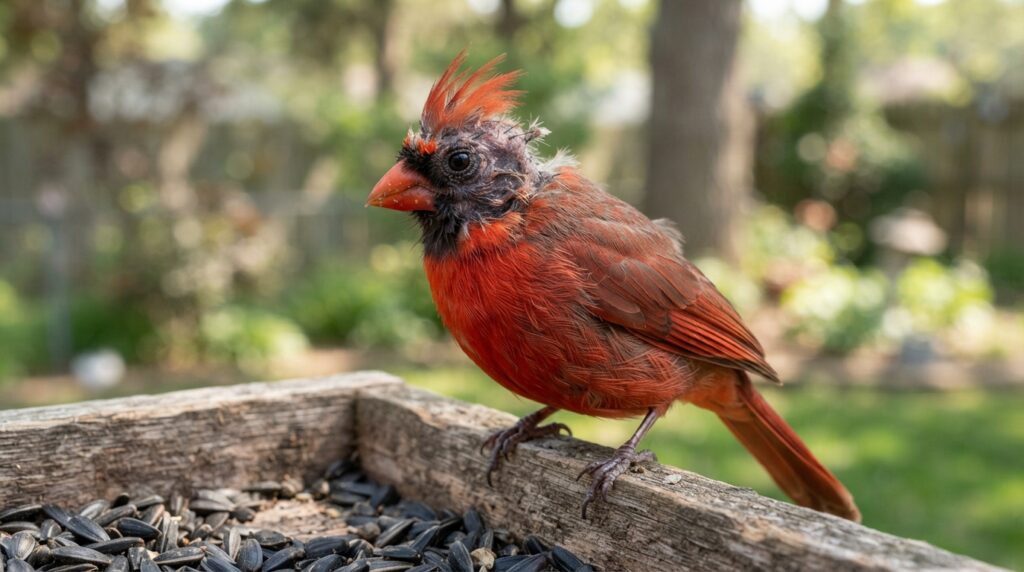
Every August and September, the same photograph does the rounds: a Northern Cardinal with a brilliant red body and a completely bald head, looking like a small vulture. Blue Jays do it too, and so occasionally do grackles and starlings.
People assume mange, disease, or a fight. It is almost always none of those.
The short version
- Timing: late summer, roughly July through September
- Cause: molt — feather replacement after the breeding season
- Why bald: some individuals shed all head feathers at once rather than gradually
- Recovery: a few weeks. New feathers are usually visible as pin-like shafts
- Species: most often Northern Cardinal and Blue Jay
- Worry level: low, unless the bird is also lethargic or has crusted eyes
What molt actually is
Feathers wear out. They are dead structures, so a bird cannot repair them, and a full set has to be replaced periodically. Most North American songbirds do this once a year, after breeding, when the demands of raising young are over and before the cold arrives.
Normally the replacement is staggered — a few feathers at a time, symmetrically, so the bird is never left with a gap that matters. You would not notice it happening.
The bald-headed birds are the exception. In some individuals the head feathers come out more or less simultaneously, leaving bare skin that looks black or dark gray. Whether an individual molts gradually or all at once appears to vary bird to bird rather than following a rule.
What it looks like
| What you see | What it means |
|---|---|
| Bare black or gray head, body feathers normal | Normal head molt |
| Short spiky shafts appearing on the head | New feathers coming in. Recovery underway |
| Ragged, patchy, generally scruffy appearance | Normal late-summer molt across the body |
| Bird eating normally, alert, flying well | Healthy. Just having a bad month |
Those new feathers are worth looking for. Emerging feathers are encased in a sheath and look like short bristles or pins, which is where the term “pinfeathers” comes from. If you can see them, the bird is already recovering.
The other possible cause
Feather mites and lice can also produce feather loss around the head, and this is genuinely part of the picture — the head is the one place a bird cannot preen, which is why parasites concentrate there and why head feathers are the ones most likely to be affected.
In practice the distinction matters less than it sounds. Both resolve, both are common, and neither is something you can or should treat in a wild bird. If the bird is feeding, alert and flying normally, the answer is the same either way: leave it alone.
When it is worth a second look
Bald head plus any of these is a different situation:
- Sitting fluffed up for long periods, easy to approach
- Swollen, crusted or weepy eyes
- Growths or lesions around the eyes, bill, legs or feet
- Visible difficulty flying or feeding
- Other birds in the yard showing similar signs
Those point toward disease rather than molt. Take feeders and baths down for one to two weeks and disinfect everything — sick birds at your feeder covers what to look for and who to report it to.
Why late summer feels so empty
The bald birds are part of a bigger seasonal pattern that alarms people every year. Molt is energetically expensive and leaves birds less able to fly well, so they go quiet, stay in cover and visit feeders less. At the same time natural food is at its annual peak.
The result is a yard that seems to empty out in August. It fills back up through September as molt finishes and migration begins. There is nothing to fix. The full list of causes for an empty feeder is here.
What actually helps a molting bird
Growing a full set of feathers takes protein, since feathers are largely keratin. High-quality food during molt is genuinely useful, even though the birds are visiting less.
- Black oil sunflower — high fat and protein, thin shell
- Sunflower chips — no cracking required, useful for a bird under strain
- Peanut pieces
- Mealworms, if you already offer them
- Water — molting birds bathe and preen heavily, and a shallow bath gets used hard in August
Black oil sunflower is the sensible choice during molt for the same reason it is the rest of the year. The honest drawback: it produces a lot of shell debris underneath, which needs raking and which will kill grass over a season. Chips avoid that at noticeably higher cost, and they spoil faster in the wet weather late summer often brings.
One thing to be more careful about in August than usual: heat spoils seed quickly, and moldy seed causes aspergillosis. Fill with less at a time and clean more often than the usual two weeks.
Common questions
Why is my cardinal bald?
Head molt. Some individuals shed all their head feathers at once instead of gradually, leaving bare dark skin. It is normal, it peaks in late summer, and feathers regrow within a few weeks.
Is a bald bird sick?
Usually not. A bird that is feeding, alert and flying well is molting. Bald head combined with lethargy, crusted eyes or difficulty flying is a different matter and warrants taking feeders down.
How long does it take for the feathers to grow back?
A few weeks. Look for short pin-like shafts on the head — those are new feathers still in their sheaths, and they mean recovery is already underway.
Which birds does this happen to?
Most often Northern Cardinals and Blue Jays. Common Grackles and European Starlings do it occasionally too.
Can I do anything to help?
Offer good food and clean water, and otherwise leave it be. Molt is a normal process, not a condition to treat, and a wild bird should not be handled.
Why do so many birds look scruffy in August?
Most songbirds molt after breeding. It is demanding, so birds go quiet and stay under cover, which is also why feeders seem to empty out at the same time every year.
Related guides
- Northern Cardinal: how to attract them
- Blue Jay
- Why aren’t birds coming to my feeder?
- Sick birds at your feeder
Sources: Cornell Lab of Ornithology, All About Birds, on molt and bald-headed birds; Project FeederWatch; National Audubon Society; Cornell Lab Birds of the World species accounts for Northern Cardinal and Blue Jay.
Trying to bring cardinals in?
Cardinals want somewhere to stand. A hopper or platform feeder suits them far better than a tube, and safflower gives them something squirrels and grackles largely ignore.
This link goes to Amazon. If you buy through it we may earn a small commission, at no extra cost to you.