
Affiliate disclosure: some links on this page go to Amazon. If you buy through one we may earn a small commission, at no extra cost to you. Full disclosure.
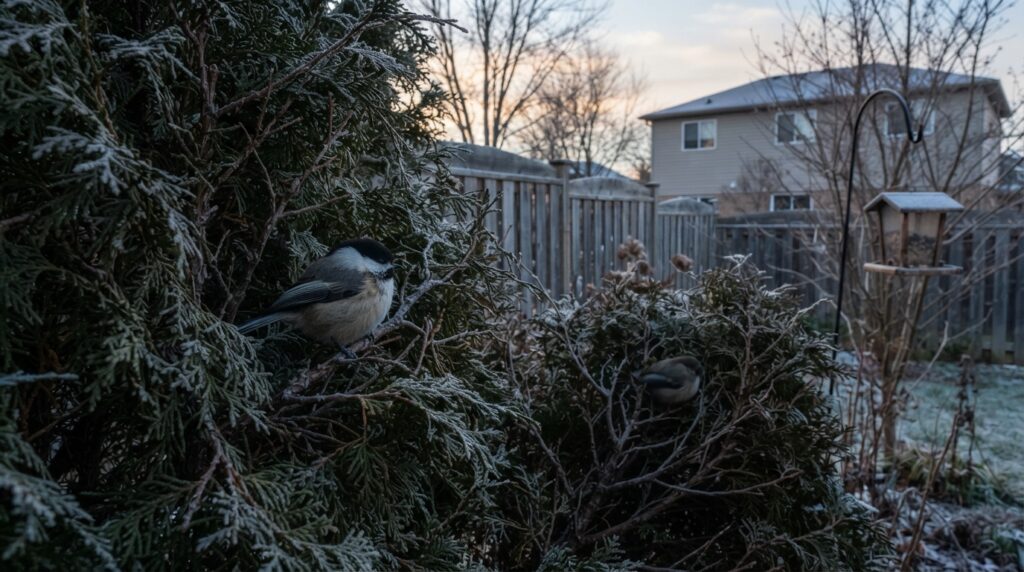
Mostly in tree cavities, dense evergreens and thick brush — wherever they can get out of the wind. Some species huddle together in a single cavity for warmth, and chickadees drop their body temperature overnight in a controlled hypothermia to save energy. The most useful thing you can do is leave your nest boxes up through winter and keep dense cover in the yard.
Feeding gets all the attention, and overnight shelter is arguably the bigger constraint. A small bird can burn a substantial share of its body weight getting through a long freezing night, and where it spends that night decides how much.
Wind is the real enemy rather than temperature. A bird in still air inside a cavity is in a completely different situation from one on an exposed branch in a 20 mph wind at the same air temperature.
Where birds actually go
- Tree cavities — chickadees, nuthatches, titmice, woodpeckers, bluebirds
- Dense evergreens — sparrows, juncos, finches, doves, cardinals
- Brush piles and thickets — wrens, sparrows, towhees
- Buildings and eaves — House Sparrows, starlings, House Finches
- Snow itself — grouse and ptarmigan burrow into it
- Nest boxes — which is why leaving them up matters
How they survive the night
Fluffing up. Raising the feathers traps a thicker layer of air against the skin. A bird that looks like a ball on a cold morning is doing the most effective insulation available to it.
Shivering. Birds shiver to generate heat, and can sustain it for hours. It is expensive, which is why the day’s calorie intake matters so much.
Tucking the bill and one leg. The bill and legs are unfeathered and lose heat fast. Tucking the bill into the shoulder feathers and standing on one leg halves that exposure.
Countercurrent heat exchange in the legs. Warm arterial blood heading into the foot runs alongside cold venous blood returning, transferring heat back into the body. This is why a bird can stand on ice without losing much warmth — the foot is kept just above freezing rather than at body temperature.
Huddling. Several species pack into one cavity on the coldest nights. Eastern Bluebirds are well documented doing this, with a dozen or more birds recorded in a single box.
Controlled hypothermia. Black-capped Chickadees do something genuinely remarkable: on cold nights they lower their body temperature substantially below daytime levels in a regulated nightly hypothermia, cutting the energy cost of the night considerably.
It is not the same as hummingbird torpor, which goes far deeper and takes twenty minutes or more to come out of. A chickadee in nightly hypothermia can still respond to danger. More on chickadees.
Leave your nest boxes up
The single most actionable thing in this article, and the one most people get wrong.
Nest boxes are not just for nesting. Chickadees, nuthatches, titmice, bluebirds, wrens and woodpeckers all use cavities to roost overnight in winter, and a box is a cavity. Taking boxes down in fall removes shelter in the months it matters most.
Clean them out in late winter instead — February in most of the country — which removes old nest material and parasites before the breeding season while leaving the box available all winter.
If you do not have boxes up, late winter is the time to add them. Hole sizes by species.
Roost boxes
A roost box is a nest box built for the opposite purpose, and the differences follow from that.
| Nest box | Roost box | |
|---|---|---|
| Entrance | Near the top | Near the bottom, so rising warm air is not lost |
| Ventilation | Yes, near the top | Minimal — the point is to retain heat |
| Inside | Bare | Staggered perches or dowels for several birds |
| Size | Sized to one pair | Taller, to hold a group |
| Season | Spring and summer | Put up in fall |
Honest assessment: roost boxes get used less reliably than nest boxes, and the evidence for how much difference they make is thinner than the marketing suggests. Birds appear to prefer natural cavities and ordinary nest boxes in many cases. If you have limited effort available, dense evergreen cover and leaving existing nest boxes up will do more.
If you buy one, check the entrance is near the bottom rather than the top — a fair number sold as roost boxes are simply nest boxes relabeled, which defeats the purpose. Untreated wood, and a side that opens for cleaning. Honest drawbacks beyond uncertain uptake: roost boxes need cleaning too, since droppings accumulate fast when several birds use one nightly, and a box with minimal ventilation can get damp inside.
Cover does more
The reliable version of all this is planting and stacking rather than buying.
- Dense evergreens — spruce, fir, cedar, hemlock, native juniper. The best winter shelter available, and a reason to think hard before removing one
- Brush piles. Free, effective, immediate. A discarded Christmas tree is a good start. How to do it
- Leave seed heads and stems standing. Coneflower, black-eyed Susan and ornamental grasses provide both food and structure. Cut back in spring, not fall
- Leave dead trees standing where they are not a hazard. Natural cavities are what most of these birds actually want
- Thick native shrubs near the feeder, about ten feet away
What not to do
- Do not put insulation, fabric or bedding in a box. It holds moisture, and damp is far more dangerous to a roosting bird than cold air
- Do not heat a box. Birds are adapted to cold; a warm box they then leave at dawn is a worse shock than a cold one
- Do not check boxes on cold nights. Flushing a roosting bird into the dark at 10°F can be fatal
- Do not do a thorough fall tidy-up. Cutting everything back and clearing brush removes the cover birds need over winter
Common questions
Where do birds sleep on freezing nights?
In tree cavities, dense evergreens, thick brush and building crevices — anywhere out of the wind. Wind matters more than air temperature for overnight survival.
Should I take nest boxes down in winter?
No. Chickadees, nuthatches, titmice and bluebirds roost in them overnight, sometimes several birds to a box. Clean them out in late winter instead.
Why do birds stand on one leg in cold weather?
To reduce heat loss from unfeathered legs. They also tuck the bill into the shoulder feathers, and countercurrent blood flow in the legs keeps the feet just above freezing without draining body heat.
Do roost boxes work?
Sometimes. Uptake is less reliable than for nest boxes and the evidence is thinner than the marketing suggests. Dense evergreen cover and leaving existing nest boxes up do more for less effort.
Should I put bedding in a box to keep birds warm?
No. Fabric and insulation hold moisture, and damp is more dangerous to a roosting bird than cold air. Leave boxes bare.
Do birds huddle together?
Several species do on the coldest nights. Eastern Bluebirds are well documented packing into a single box, with a dozen or more birds recorded together.
Related guides
- Nest box hole sizes by species
- Turn your Christmas tree into a brush pile
- Winter bird feeding in the Upper Midwest and Northeast
- Black-capped Chickadee
Sources: Cornell Lab of Ornithology, All About Birds, Birds of the World and NestWatch, on winter roosting, nest box use outside the breeding season and thermoregulation; research on regulated nocturnal hypothermia in Black-capped Chickadees; National Audubon Society; state wildlife agency and university extension guidance on winter cover and roost boxes.
Want a closer look?
A pair of 8x42 binoculars is the single thing that changes backyard birding most. Close focus matters more than magnification when the bird is fifteen feet away.
This link goes to Amazon. If you buy through it we may earn a small commission, at no extra cost to you.