
Affiliate disclosure: some links on this page go to Amazon. If you buy through one we may earn a small commission, at no extra cost to you. Full disclosure.
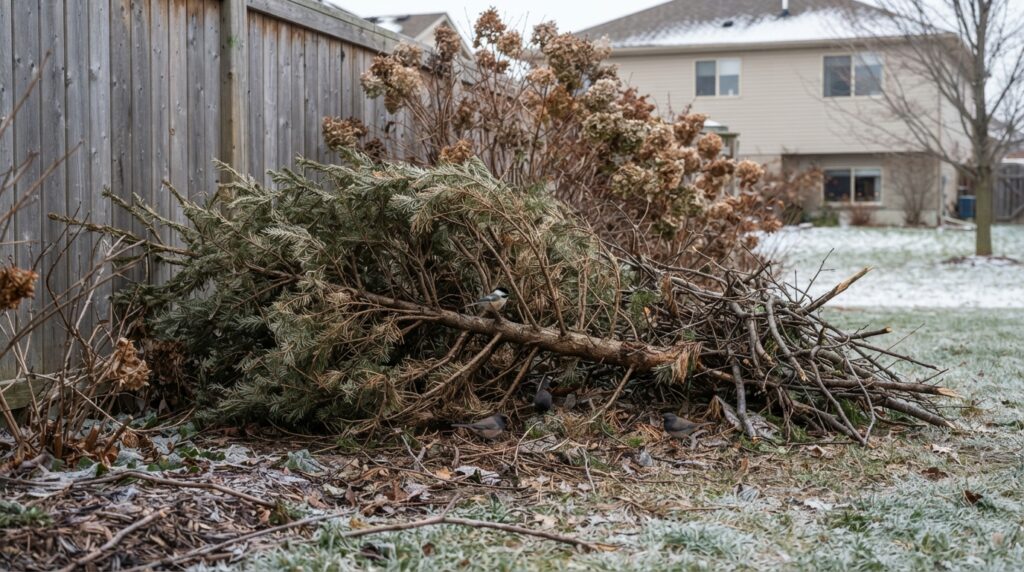
Strip every piece of tinsel, wire, hook and ribbon off it, then stand or lay it near your feeder as winter cover. A real tree keeps its needles for weeks outdoors and provides dense shelter in January and February, which is exactly when natural cover is thinnest and birds need somewhere to dive when a hawk comes through. Do not use a flocked or artificially colored tree.
The tree comes down on New Year’s Day and goes to the curb, and that is a slightly wasted opportunity. Dense evergreen cover is the scarcest thing in a winter yard, and you have just been given some for free.
This takes about ten minutes and costs nothing.
The short version
- Strip everything artificial off — tinsel, wire, hooks, ribbon, flocking
- Real trees only. Not flocked, not spray-colored, not artificial
- Site it about 10 feet from the feeder — near cover, not on top of it
- Standing or laid on its side both work
- Add more over time — prunings, more trees, into a proper pile
- It breaks down over a year or two and feeds the soil
Why cover matters in January
Winter is when yards are most exposed. Deciduous shrubs are bare, perennials are cut back, and a feeder in an open lawn leaves small birds with nowhere to go.
Three things dense cover provides:
Escape from predators. Cooper’s and Sharp-shinned Hawks hunt feeders deliberately, coming in fast and low. Birds need somewhere to dive within about a second. Cover roughly ten feet from the feeder is the working distance — closer gives a cat an ambush point, further is unreachable in the time available. More on hawks at feeders.
Shelter from wind. Wind chill is the thing that kills small birds overnight. Dense evergreen branches on the lee side of a pile create a pocket of still air, and that difference is significant for a bird weighing half an ounce.
Roosting. Sparrows, juncos, wrens and finches roost in dense vegetation. A tree that still has its needles is a functioning roost site through the coldest weeks of the year.
Strip it first
This is the part that matters and the part people rush.
- Tinsel is the worst offender. Strands get swallowed or wrapped around legs and feet
- Wire ornament hooks catch birds and are almost invisible against branches
- Ribbon, string and garland cause entanglement
- Fishing line, if anyone used it to hang anything
- Plastic and glass fragments from broken ornaments
Go over the tree in daylight before it goes outside. Then go over it again. Wire hooks in particular are easy to miss and end up in the pile for years.
Do not use a flocked tree. The artificial snow coating is not something to leave weathering in a yard where birds are feeding, and the same goes for spray-colored trees. Those go to municipal collection.
Artificial trees obviously do not apply — they do not decompose and contribute nothing.
Where to put it
- About ten feet from the feeder. Near enough to reach, far enough not to be an ambush point
- Against a fence, wall or hedge line rather than in the middle of open lawn — it looks tidier and gives more shelter
- Somewhere you do not need to walk for the next year
- Away from the house foundation, since a brush pile is also habitat for rodents. Ten or fifteen feet out is sensible
- Standing, propped or laid flat — all work. Standing it in an old pot or lashing it to a stake keeps it upright through wind
Building it up
One tree is useful. A proper brush pile is considerably better, and a discarded tree is a good starting frame.
The traditional method: lay the heaviest material at the bottom in a loose criss-cross to create open spaces underneath, then pile lighter branches on top. What matters is the gaps — a solid heap of compacted material is no use to anything. Birds need to get inside.
Add to it through the year with prunings, storm-fallen limbs and next year’s tree. A pile built up over three or four years becomes one of the best wildlife features a yard can have.
Other uses for the tree
- Sink it in a pond, if you have one and it is legal locally — it becomes fish habitat
- Cut the branches off and lay them over perennial beds as winter mulch, using the trunk as a stake or edging
- Chip it for mulch if you have access to a chipper
- Hang it with bird food — suet, seed-covered pinecones, orange halves. A genuinely good thing to do with children on the day after Christmas
- Check municipal recycling. Many towns chip trees for public parks, which is a perfectly good outcome if your yard has no room
If you hang food on the tree, a proper suet cage with a tail prop is worth having rather than improvising — woodpeckers brace against the extended back panel and feed far more comfortably. Honest drawbacks: cheap wire cages rust through in two or three seasons, and any suet feeder gets taken over by starlings unless it is an upside-down design. More on that.
Two honest caveats
It is habitat for rodents too. A brush pile shelters mice and rats as readily as birds. Site it well away from the house and from sheds, and if you already have a rodent problem under your feeder, deal with the spilled seed first. How to do that.
Check local rules. Some HOAs restrict brush piles and yard debris, and in fire-prone areas defensible-space regulations generally prohibit combustible material within a set distance of structures. In the wildland-urban interface, a brush pile near the house is a genuine hazard rather than a bureaucratic one.
Common questions
How long will a Christmas tree last outside?
A real tree holds its needles for several weeks outdoors in cold weather, which covers the period birds most need cover. The bare branches remain useful as structure for a year or more after that.
Can I use a flocked tree?
No. Artificial snow coating and spray colorants are not something to leave weathering in a yard where birds are feeding. Send flocked trees to municipal collection.
How close to the feeder should it go?
About ten feet. Close enough that birds can reach it when a hawk comes through, far enough that a cat cannot use it as an ambush point.
Will it attract rats?
A brush pile shelters rodents as well as birds. Site it well away from the house and sheds, and deal with spilled seed under the feeder, which is the actual food source.
What do I need to take off first?
Everything artificial: tinsel, wire hooks, ribbon, garland, fishing line and any broken ornament fragments. Tinsel and wire hooks are the dangerous ones. Check twice in daylight.
Which birds will use it?
Sparrows, juncos, wrens, finches and chickadees use dense cover for shelter and roosting. It also gives every bird at your feeder somewhere to escape to.
Related guides
- Winter bird feeding in the Upper Midwest and Northeast
- Where do birds sleep in winter?
- A hawk is hunting my feeder
- Mice and rats under the bird feeder
Sources: Cornell Lab of Ornithology, All About Birds and Project FeederWatch, on cover, feeder placement and winter shelter; National Audubon Society guidance on brush piles and yard habitat; state wildlife agency and university extension guidance on brush pile construction; Firewise USA and state fire agency guidance on defensible space in the wildland-urban interface.
Want a closer look?
A pair of 8x42 binoculars is the single thing that changes backyard birding most. Close focus matters more than magnification when the bird is fifteen feet away.
This link goes to Amazon. If you buy through it we may earn a small commission, at no extra cost to you.