
Affiliate disclosure: some links on this page go to Amazon. If you buy through one we may earn a small commission, at no extra cost to you. Full disclosure.
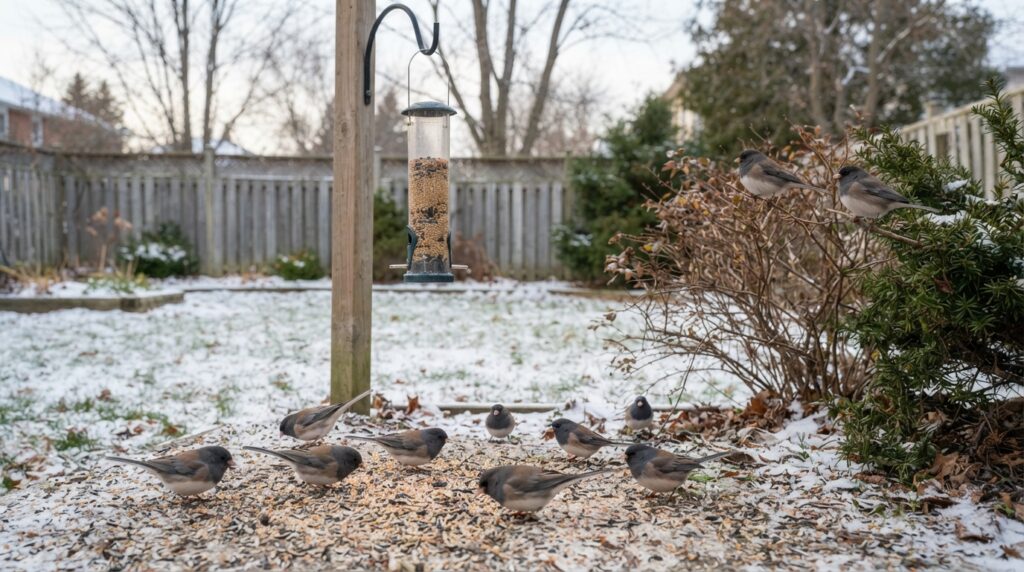
Across most of the US, Dark-eyed Juncos arrive in fall as the weather turns, usually from late September into October, and head north again by April. They’re ground feeders: they pick up seed under the feeder rather than on it. Scatter white proso millet or hulled sunflower on the ground or on a low platform, near shrubs they can dart into, and a flock will often come back to the same yard all winter.
For a lot of people in the eastern half of the country, the first junco under the feeder is the real start of winter. That’s why they’re nicknamed snowbirds: as Cornell Lab’s All About Birds puts it, over most of the eastern United States they appear as winter sets in and retreat north each spring.
They’re also everywhere. Project FeederWatch describes the Dark-eyed Junco as typically the most common feeder bird in North America.
The essentials
- Arrive: late September–October in most areas
- Leave: March–April
- Feed on the ground, under and around feeders
- Favorite seed: white proso millet, then sunflower
- ID in a second: white outer tail feathers flashing as it flies
- Winter flocks with a strict pecking order
How to recognize a junco
A junco is a small sparrow, but it doesn’t look like the streaky brown sparrows. In the East it’s plain slate gray above and on the breast, with a clean white belly and a pale pink bill, like a small gray bird dipped in snow from below.
The one mark that works everywhere, for every form, is the tail. When a junco flies up, it flashes bright white outer tail feathers on each side. All About Birds highlights this as the key thing to look for when a flock flushes from the ground.
Watch them feed and you’ll notice they hop rather than walk, picking seed off the ground and often scratching in leaf litter.
The forms you’ll see depend on where you live
The Dark-eyed Junco varies a lot across the country. Audubon notes there are more than a dozen subspecies, five of which were considered separate species until the 1970s. The main forms, according to the Audubon field guide:
| Form | Looks | Where |
|---|---|---|
| Slate-colored | Solid gray above, white belly | The only form usually seen in the East |
| Oregon | Black or dark gray hood, chestnut back, buff sides | Widespread in the West; rare in the East |
| Pink-sided | Paler gray hood, broad pinkish sides | Nests in the north-central Rockies, winters farther south |
| Gray-headed | Gray head and sides, reddish back patch | Central Rockies and Great Basin mountains |
| White-winged | Pale gray, white wing-bars, more white in the tail | Nests in the Black Hills of South Dakota |
| Red-backed | Gray with a reddish back | Resident in the mountains of northern Arizona and New Mexico |
If you’re in the Mountain West, you may see several forms in the same flock. In the East, an Oregon-type junco among the Slate-coloreds is a notable find worth reporting to eBird or FeederWatch.
When they arrive and leave
Juncos breed on the forest floor across Canada and in the western mountains, from sea level to more than 11,000 feet, according to All About Birds, and spread across most of the lower 48 in winter.
- North and Midwest: often the first arrivals, from late September. Illinois DNR notes the earliest fall migrants can appear as soon as August, though most come later
- Mid-South: the Tennessee Wildlife Resources Agency gives early October to mid-April across most of the state
- Year-round: in the high Appalachians (Tennessee’s mountains, especially above 4,000 feet, and parts of western Maryland), in western mountains, and along parts of the southern Pacific Coast, some juncos stay all year and move up or downslope with the seasons
The exact date shifts with the weather each year. The first hard cold snap of fall often brings a noticeable wave.
Why you might see more females in the South
This is one of the best-studied patterns in American birds. Research by Ellen Ketterson and Val Nolan in the 1970s showed that female juncos winter farther south than males. A 2024 study in Frontiers in Bird Science, by Ketterson and colleagues, confirms that females winter farther from the breeding range and at more southerly latitudes, and that the pattern tracks winter climate.
One leading explanation is that males, which compete for breeding territories in spring, benefit from wintering closer to them. The practical upshot: in a northern yard your flock may be mostly males, and in a southern one mostly females. The same study also found a recent northward shift, with more females wintering at higher latitudes than in the 1970s.
How to feed juncos
All About Birds says seeds make up about 75% of a junco’s year-round diet, and that juncos prefer millet over sunflower seed at feeders. Project FeederWatch’s advice is a handful of millet sprinkled on the ground to keep juncos and sparrows happy.
| Food | Notes |
|---|---|
| White proso millet | The top choice. Scatter on the ground or a low platform |
| Hulled sunflower (chips or hearts) | Taken readily; no shells to crack. Offer only what gets eaten in a day or two, since hulled seed spoils fast |
| Black oil sunflower | Eaten, especially bits dropped by other birds |
| Nyjer and fine chips | Picked up from under finch feeders |
Straight white proso millet is the seed juncos go for first, and buying it on its own is cheaper than paying for a mix where it’s only part of the bag. Honest drawbacks: All About Birds warns that millet also draws House Sparrows and Brown-headed Cowbirds, which can crowd out smaller birds; any seed scattered on the ground will sprout if it isn’t eaten; and it attracts doves, which may or may not be welcome. Put out small amounts that get cleared each day.
Where to put it
- On the ground or a low platform feeder, not a hanging tube. Audubon notes juncos will come to feeders but tend to forage on the ground underneath
- Within a short dash of cover: shrubs, an evergreen or a brush pile. Juncos flush to cover at the first sign of a hawk
- Away from where cats can hide. Ground feeders are the most vulnerable birds in any yard. Cats and birds
- Clear a patch after snow. Sweeping or shoveling a small area and scattering seed there helps a lot during storms. Feeding through snow and ice
A brush pile is one of the best things you can offer. It gives juncos cover while feeding and shelter overnight. After the holidays, a discarded Christmas tree does the job.
Winter flocks and the pecking order
Juncos travel in winter flocks, and All About Birds notes those flocks usually have a strict hierarchy. Audubon adds that males tend to dominate females, and older birds rule over younger ones. You’ll see it at the seed: a bird raises its tail and flashes the white feathers or lunges at another to claim a spot.
Flocks often return to the same wintering area year after year, according to the University of Michigan’s Animal Diversity Web. The juncos under your feeder in January may well be the same individuals as last winter.
How they’re doing
Partners in Flight estimates a global breeding population of about 220 million, and All About Birds lists the species as Low Concern. The North American Breeding Bird Survey shows a decline of about 0.7% a year between 1966 and 2019, a cumulative drop of 31%. Common, but not immune to the broader decline in North American birds.
Common questions
When do juncos arrive in fall?
Usually from late September into October in the North and Midwest, and early October across much of the mid-South. They leave again by about April.
What seed do juncos like best?
White proso millet. Cornell Lab says juncos prefer millet to sunflower seed at feeders. Hulled sunflower is also taken readily.
Why don’t juncos use my hanging feeder?
They’re ground feeders. Scatter seed on the ground or put out a low platform feeder near cover.
Why are they called snowbirds?
Across most of the eastern US, they arrive as winter sets in and leave in spring, so they seem to come with the snow.
Are juncos sparrows?
Yes. They belong to the American sparrow family, alongside White-throated and Song Sparrows. Small brown birds
Do juncos stay all summer?
Only in some mountain areas, including the high Appalachians and western mountains. Elsewhere they breed farther north.
Related guides
- Getting your feeders ready for fall and winter
- Small brown birds: how to tell them apart
- Project FeederWatch
- Winter bird feeding in the Upper Midwest and Northeast
Sources: Cornell Lab of Ornithology, All About Birds, Dark-eyed Junco overview and life history, and “Types of bird seed: a quick guide”; Project FeederWatch, Top 25 feeder birds and feeding guidance; National Audubon Society, Dark-eyed Junco field guide and “10 Fun Facts About the Dark-eyed Junco”; O’Neal, Austin and Ketterson, Frontiers in Bird Science, 2024, on differential migration; Ketterson, E.D. and Nolan, V., Ecology 57, 1976; Tennessee Wildlife Resources Agency; Illinois Department of Natural Resources; Maryland Department of Natural Resources; University of Michigan, Animal Diversity Web.
Feeding ground birds?
Juncos, sparrows and doves feed low. A platform feeder with a mesh floor keeps seed off wet ground. Place it near shrubs they can dart into, and clean it often.
This link goes to Amazon. If you buy through it we may earn a small commission, at no extra cost to you.