
Affiliate disclosure: some links on this page go to Amazon. If you buy through one we may earn a small commission, at no extra cost to you. Full disclosure.
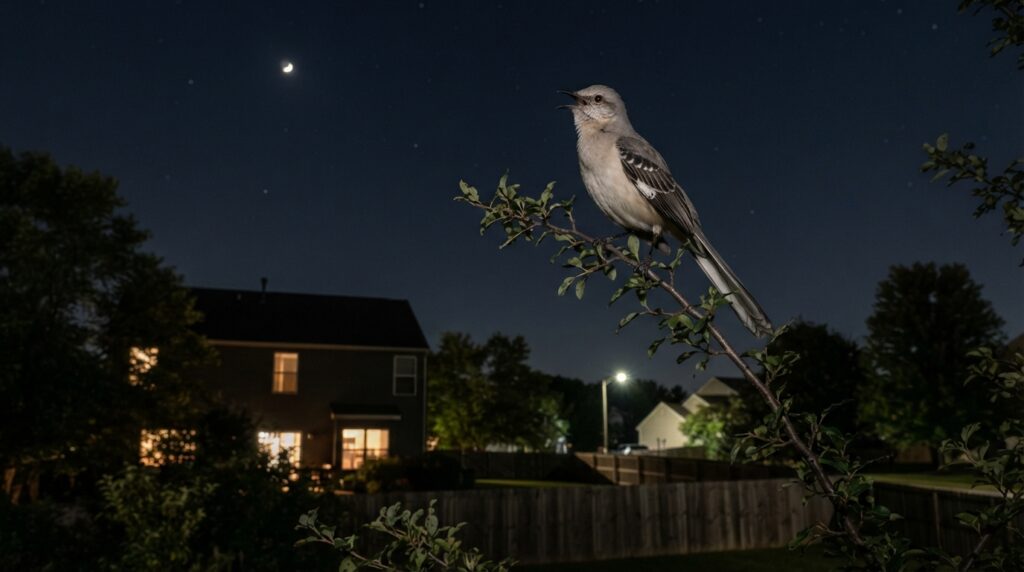
A bird singing a long, varied medley all night in spring is almost always a male Northern Mockingbird that hasn’t found a mate. According to Cornell Lab, most nocturnal singers are unmated males, and night singing is especially common around the full moon. It usually lasts a couple of weeks and fades once he pairs up. The bird is federally protected, so the realistic options are waiting it out, earplugs or white noise.
It’s 2 a.m. and something outside is running through a playlist: a cardinal, a car alarm, a Blue Jay, something that sounds like a squeaky gate, each phrase repeated a few times before switching to the next. It stops for a minute. Then it starts again.
That’s a Northern Mockingbird, and he’s not malfunctioning. He’s advertising.
The essentials
- Who: usually an unmated male
- When: mainly spring, especially on bright moonlit nights
- How long: night singing often lasts two to three weeks at most
- Why: attracting a female and claiming territory
- Repertoire: a male may learn around 200 songs in his life
- Protected under the Migratory Bird Treaty Act
How to know it’s a mockingbird
Mockingbirds sing phrases in sets. Cornell Lab’s All About Birds describes each phrase being repeated two to six times before the bird moves on to a new one. That repetition is the giveaway: a real cardinal or Carolina Wren would repeat its own song, but it wouldn’t switch to a jay and then a frog.
The bird itself is slim, long-tailed and gray, with flashing white patches in the wings and tail when it flies. It often sings from the highest point around, such as a rooftop, chimney, antenna or treetop.
The free Merlin Bird ID app from the Cornell Lab can confirm it by sound. It may also list several species at once, since the mockingbird is impersonating them.
Why he sings at night
All About Birds is specific: most nocturnal singers are unmated males, which also sing more than mated males during the day. The song is how a male advertises himself to females and warns rivals off his territory. A bachelor has every reason to keep going.
Research backs that up. In a study published in The Auk in 1983, researcher C.A. Logan found that unmated males often sang in bouts approaching a full hour, while mated males rarely sang for more than 15 minutes at a stretch, and sang even less once they were incubating and feeding young.
The moon and the lights
The Texas Breeding Bird Atlas notes unmated males may sing all night, especially around the full moon, and Florida’s official state bird description mentions bright springtime moonlight. Tennessee’s wildlife agency refers to moonlit spring nights.
Artificial light is a likely factor too, though the evidence is indirect. Research on American Robins by M.W. Miller, published in The Condor in 2006, found that robins in brightly lit areas often started their dawn chorus in full darkness. No study has pinned down the same effect for mockingbird night song specifically, but a mockingbird singing beside a streetlight or security light isn’t unusual.
How long it will last
This is what most people want to know. Mass Audubon says nighttime singing happens during the breeding season, in late spring and early summer, and usually lasts only two or three weeks at the most. It can start again briefly in midsummer, when males are trying for a second brood.
Mockingbirds also sing in fall. All About Birds says they typically sing from February through August, then again from September to early November. According to Texas Parks and Wildlife, both males and females sing in fall to claim winter feeding territories, and the Tennessee Wildlife Resources Agency cites a study that found only a 1% overlap between the song types a bird used in spring and in fall. Fall singing is usually a daytime affair, though, and much less intense.
What you can do
Mockingbirds are protected under the Migratory Bird Treaty Act, so trapping, removing or harming one isn’t an option without a federal permit. That leaves:
- Earplugs or white noise. This is Mass Audubon’s own suggestion, and it works
- Close the window on that side of the house for a couple of weeks if you can
- Turn off unneeded outdoor lights. It’s not proven to stop a mockingbird, but it costs nothing and is better for birds and insects generally
- Wait. Once he finds a mate, the night singing usually stops
A small white noise machine is the most practical answer for a few weeks of broken sleep, and it’s what Mass Audubon suggests alongside earplugs. Honest drawbacks: it masks the song rather than blocking it, so a mockingbird right outside an open window will still get through; some people find constant noise disruptive in its own right; and a fan or a free app can do much the same job. Soft foam earplugs are the cheapest option of all.
Other birds that sing at night
| Bird | What you hear | Where |
|---|---|---|
| Northern Mockingbird | Long medley, each phrase repeated several times | South year-round; spreading north |
| American Robin | Cheery caroling, before dawn in lit areas | Nationwide |
| Yellow-breasted Chat | Odd whistles, clucks and rattles, often at night at the height of breeding | Brushy areas, much of the US in summer |
| Eastern Whip-poor-will | Endlessly repeated whip-poor-WILL | Eastern woodlands in summer |
| Chuck-will’s-widow | Repeated chuck-will’s-WID-ow at dusk and at night | Southeast in summer |
Whip-poor-wills and Chuck-will’s-widows are night birds by design. The mockingbird, robin and chat are daytime birds singing into the night.
If the mockingbird is dive-bombing you
The other common mockingbird complaint comes a little later in spring. Audubon notes they attack cats and even people who come too close to the nest, and the Tennessee Wildlife Resources Agency says they’ll dive at homeowners and pets.
It’s temporary. All About Birds gives an incubation period of 12 to 13 days and a nestling period of 12 to 13 days. University of Florida IFAS Extension advises avoiding the area for the nesting season where possible, noting the attacks stop once the young are fully independent. A hat or an umbrella helps in the meantime.
Don’t take it personally, although the bird might. A 2009 study led by Douglas Levey at the University of Florida, published in PNAS, found mockingbirds learned to recognize individual people who had approached their nests, after as little as 60 seconds of exposure, and flushed earlier and attacked those people but not strangers.
A few mockingbird facts
- It’s the state bird of Arkansas, Florida, Mississippi, Tennessee and Texas
- It doesn’t migrate, and Audubon notes its range has expanded north, especially in the Northeast
- Audubon Magazine reports a 2019 study found mockingbirds imitating at least 12 species of frogs and toads
- Pairs raise two or three broods a year, according to All About Birds
Common questions
Why is a bird singing at 3 a.m.?
In spring, usually an unmated male Northern Mockingbird advertising for a mate. Robins also sing before dawn in brightly lit areas.
How long will the mockingbird sing at night?
Mass Audubon says night singing usually lasts two or three weeks at most, and often stops once the male finds a mate.
Can I get rid of a mockingbird?
Not legally without a federal permit. Mockingbirds are protected under the Migratory Bird Treaty Act. Earplugs and white noise are the practical answer.
Do female mockingbirds sing?
Rarely in the breeding season, but both sexes sing in fall to defend winter feeding territories.
Why is a mockingbird attacking me?
You’re near its nest. Attacks stop once the young are independent, usually within a few weeks. Mockingbirds can recognize individual people who approach their nest.
How many songs does a mockingbird know?
Cornell Lab says a male may learn around 200 songs over his life, and keeps adding new ones as he ages.
Related guides
- Why is a bird attacking my window?
- Common backyard birds of North America
- Feeding backyard birds in the Southeast
- American Robin
Sources: Cornell Lab of Ornithology, All About Birds, Northern Mockingbird overview, life history and sounds, and Yellow-breasted Chat, Eastern Whip-poor-will and Chuck-will’s-widow accounts; National Audubon Society, Northern Mockingbird field guide and “10 Fun Facts About the Northern Mockingbird”; Mass Audubon, Northern Mockingbirds; Texas Parks and Wildlife Department; Texas Breeding Bird Atlas, Texas A&M University; Tennessee Wildlife Resources Agency; Florida Department of State, state symbols; Logan, C.A., The Auk 100(2), 1983; Miller, M.W., The Condor 108(1), 2006; Levey, D.J. et al., PNAS, 2009, reported by the University of Florida; University of Florida IFAS Extension; US Fish & Wildlife Service, Migratory Bird Treaty Act.
Want a closer look?
A pair of 8x42 binoculars is the single thing that changes backyard birding most. Close focus matters more than magnification when the bird is fifteen feet away.
This link goes to Amazon. If you buy through it we may earn a small commission, at no extra cost to you.