
Affiliate disclosure: some links on this page go to Amazon. If you buy through one we may earn a small commission, at no extra cost to you. Full disclosure.
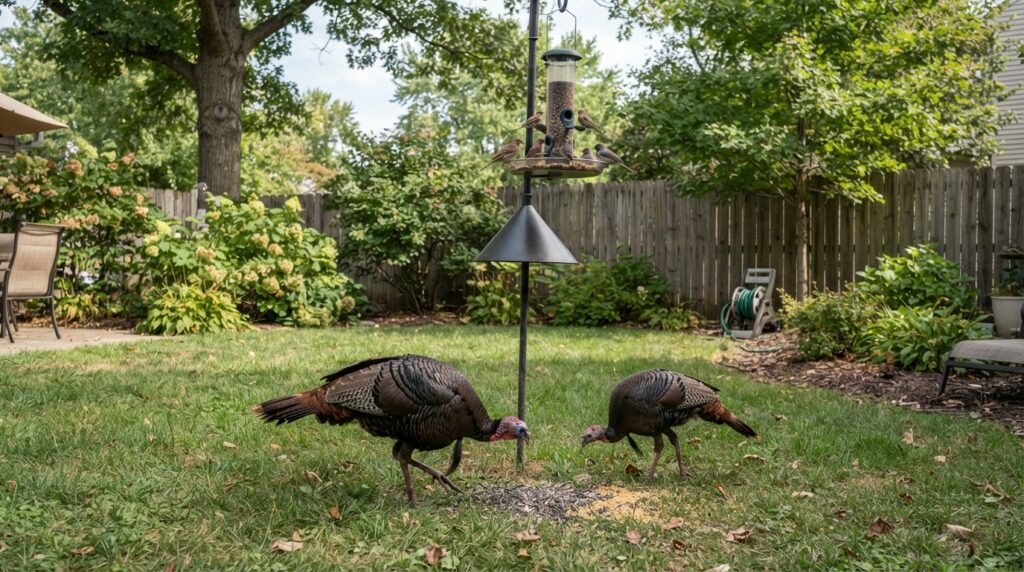
Turkeys come for the seed that falls from your feeders. State wildlife agencies are consistent: stop the spill, and the turkeys lose interest. Use feeders that keep seed off the ground, rake up spilled seed daily, or take feeders down for a few weeks if a flock has settled in. Don’t let turkeys get comfortable around people. Scare them off with noise, water or an opened umbrella, especially before the spring breeding season, when habituated birds can turn bold and aggressive.
A dozen wild turkeys strolling across the yard to clean up under the feeder is one of the more surprising sights of suburban America. A century ago it would have been almost impossible. Today, in towns from Massachusetts to Oregon, it’s routine, and so are the complaints: droppings on the deck, a gobbler pecking at the car, a hen that won’t let the kids past the driveway.
Almost every one of those problems starts at the bird feeder.
The essentials
- The draw: seed spilled on the ground under feeders
- The fix: stop the spill, or pause feeding for a while
- The risk: fed turkeys lose their fear of people
- Worst season: March through May, breeding season
- Don’t run away from an aggressive turkey
- Managed by states as game birds, not under the Migratory Bird Treaty Act
Why turkeys are at your feeder
MassWildlife is blunt about it: turkeys in suburban and urban areas rely heavily on bird seed in and around feeders, and can become quite habituated to specific locations. The North Carolina Wildlife Resources Commission says most problems with wild turkeys stem from birds being fed, intentionally or not.
Turkeys can’t use a hanging feeder, but every feeder spills. Birds flick seed aside to get to the kernels they want, squirrels knock it loose, wind blows hulls and seed onto the lawn. To a turkey flock, that’s a daily buffet in the same place, and they’ll build their route around it.
Winter makes it worse. The Connecticut Department of Energy and Environmental Protection reports turkey flocks commonly of 10 to 20 birds, and occasionally up to 100. A flock that size can empty the ground under a feeder in minutes.
Why it matters: from tame to bold
The concern isn’t the seed. It’s what regular feeding does to turkey behavior.
Massachusetts wildlife officials explain that feeding creates unnaturally high concentrations of turkeys in neighborhoods, keeps them in small areas, and makes them lose their natural fear of people. Turkeys live in flocks organized by a pecking order, and MassWildlife notes they may try to dominate or attack people they view as subordinates, most often in breeding season.
That’s how a flock that seemed charming in January becomes a gobbler chasing the mail carrier in April. MassWildlife also warns that once bold behavior is established, it can be very difficult to change, which is why the time to act is before it starts.
How to stop the spill
- Use feeders designed to keep seed off the ground. MassWildlife and the Minnesota DNR both recommend this. A tray or catcher under the feeder, or a feeder with a built-in seed tray, catches much of what falls
- Switch to no-waste seed. Hulled sunflower hearts or chips leave no shells and less for birds to discard. More on no-mess seed
- Clean up daily. The Minnesota DNR advises cleaning up spilled seed from other types of feeders every day
- Feed less. Put out only what birds finish by evening, so nothing is left on the ground overnight or in the morning
- Pause feeding. If a flock has already settled in, the Minnesota DNR says to temporarily discontinue feeding until the flock moves on
- Take feeders down in spring. Minnesota DNR suggests removing feeders in spring, when natural food is plentiful. That also happens to be when turkey aggression peaks
A seed catcher tray that fits under a pole-mounted feeder is the simplest way to follow the “keep seed off the ground” advice. Honest drawbacks: it catches most of the spill, not all of it; it holds wet seed and hulls that go moldy if not emptied, so Cornell’s advice on cleaning feeder trays applies; and a tray mounted too low becomes a turkey feeder in its own right. Mount it high and empty it every day or two.
How to make turkeys feel unwelcome
Massachusetts officials recommend making turkeys uncomfortable in your yard rather than tolerating them. Their suggestions:
- Loud noises: shouting, clapping or an air horn
- Spraying water from a hose
- Swatting toward them with a broom, or using a leaf blower
- A dog on a leash
- Making yourself look bigger: raising your arms, holding your jacket open, or opening and closing an umbrella
MassWildlife adds that Mylar tape, balloons or pinwheels may help in places where turkeys aren’t yet highly habituated.
If a turkey comes at you, stand your ground. Massachusetts officials advise never turning your back on an aggressive turkey or running away, because the bird reads that as submission and it reinforces the behavior. Make yourself big, make noise, and move toward it if it’s safe to.
If a turkey is repeatedly threatening children or older people, call your state wildlife agency.
Turkeys pecking at cars and windows
A turkey pecking at a car door, a hubcap or a glass door is fighting its own reflection. It’s the same territorial behavior covered in why a bird attacks a window, just much bigger. Massachusetts advises covering or disguising shiny surfaces the birds are reacting to, and the North Carolina Wildlife Resources Commission suggests soap, paint or tape on windows to break up the reflection. A car cover or moving the car into the garage for a few weeks usually ends it.
Disease at shared feeding sites
The Connecticut DEEP recommends against feeding turkeys partly because it encourages the spread of disease. The Pennsylvania Game Commission notes that avian pox, a virus causing wart-like growths on the head and feet, most commonly affects turkeys and doves among wild birds in Pennsylvania, and is often transmitted where birds gather at feeders. During an outbreak, the Commission recommends cleaning feeders and baths with one part bleach to nine parts water. Sick birds at your feeder.
Is it illegal to feed turkeys?
It depends where you live. Wild turkeys are not covered by the federal Migratory Bird Treaty Act. They’re game birds managed by each state, with regulated hunting seasons. Every state agency discourages feeding them, and some towns go further:
- Bandon, Oregon made it unlawful to intentionally feed wild turkeys within city limits in 2019, with fines for violations
- Westford, Massachusetts has a wildlife feeding bylaw under which a bird feeder found to be causing a wildlife nuisance must be removed, along with seed debris, within 48 hours
Check your town or county ordinances, and your HOA rules, if turkeys are an issue in your neighborhood.
A remarkable comeback
Turkeys in the suburbs are a conservation success story. Estimates of the low point vary: Audubon cites a continental population of about 30,000 birds in the early 1930s, while the USDA gives around 200,000 by the 1930s. Either way, the species had vanished from much of its range. Massachusetts’ last native turkey was killed in 1851, and New York’s disappeared in the 1840s.
Reintroduction programs brought them back. In Massachusetts, 37 turkeys trapped in New York were released in the Berkshires in the 1970s; the state now has 30,000 to 35,000. Partners in Flight estimates a global breeding population of about 6.9 million, according to Cornell Lab. They adapted so well to suburbs that living alongside them is now the challenge.
Common questions
How do I keep turkeys away from my bird feeder?
Stop seed reaching the ground: use a catcher tray or no-mess seed, clean up spilled seed daily, or pause feeding for a few weeks until the flock moves on.
Should I feed wild turkeys in winter?
No. New York DEC says feeding turkeys in harsh winters is generally not recommended or needed, and healthy turkeys can survive up to two weeks without food.
Why is a turkey chasing me?
It sees you as lower in its pecking order, usually because it’s become used to people, often through feeding. Don’t run. Make yourself big and loud.
Why is a turkey pecking my car?
It’s attacking its reflection. Cover the shiny surface or move the car for a few weeks.
Are wild turkeys protected?
They’re not covered by the Migratory Bird Treaty Act, but they are protected under state law as game birds. Hunting is allowed only in regulated seasons with a license.
Will a baffle stop turkeys?
No. Turkeys eat from the ground, not the feeder. Controlling spilled seed is what matters.
Related guides
- Deer eating your bird seed
- Bears and bird feeders
- Mice and rats under the bird feeder
- Bird seed sprouting under your feeder
Sources: MassWildlife (Massachusetts Division of Fisheries and Wildlife), “Learn about turkeys,” “Prevent conflicts with turkeys,” living with turkeys fact sheet, and spring 2026 guidance on aggressive turkeys; Minnesota Department of Natural Resources, Living with wildlife: turkeys; New York State Department of Environmental Conservation, Wild Turkey; North Carolina Wildlife Resources Commission; Connecticut Department of Energy and Environmental Protection, Wild Turkey fact sheet; Pennsylvania Game Commission, Avian pox; City of Bandon, Oregon, wild turkey feeding ordinance; Town of Westford, Massachusetts, wildlife feeding bylaw; National Audubon Society; US Department of Agriculture; Cornell Lab of Ornithology, All About Birds, Wild Turkey; Blomberg et al., Ornithological Applications 124(1), 2022.
Cutting down on spilled seed?
Hulled sunflower hearts leave no shells and far less waste on the ground. They spoil faster than seed in the shell, so put out only what gets eaten in a day or two.
This link goes to Amazon. If you buy through it we may earn a small commission, at no extra cost to you.