
Affiliate disclosure: some links on this page go to Amazon. If you buy through one we may earn a small commission, at no extra cost to you. Full disclosure.
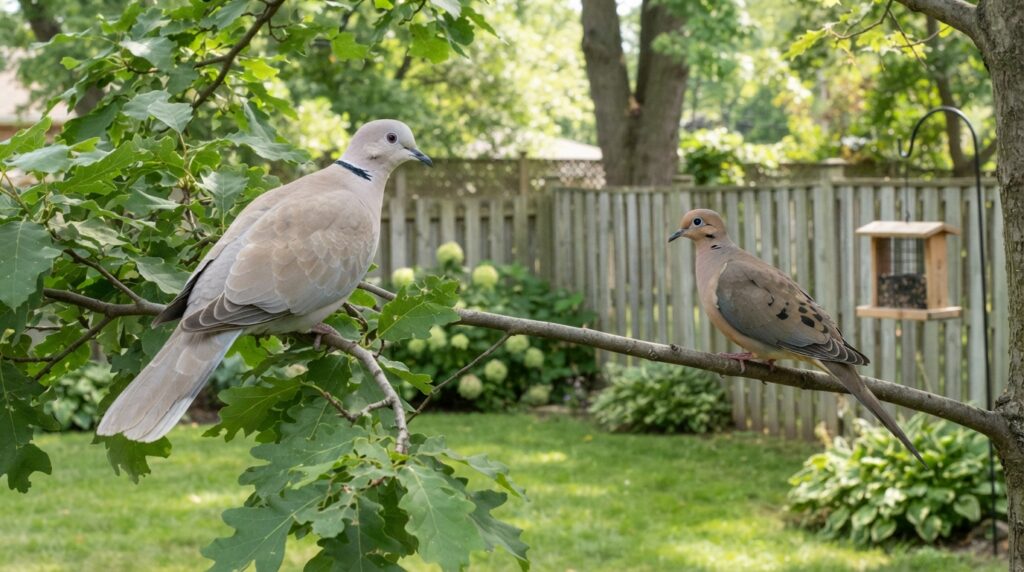
Look at the neck and the tail. A Eurasian Collared-Dove is pale gray-buff with a narrow black half-collar on the back of the neck and a squared-off tail with broad white patches. A Mourning Dove is warmer brown with black spots on the wings, no collar, and a long, pointed tail. The calls differ too: the collared-dove gives a three-part koo-KOO-kook, the Mourning Dove a soft, sad coo-OO, oo, oo, oo.
If a pale, chunky dove with a black ring on its neck has started showing up under your feeder, you’re watching one of the fastest bird invasions ever recorded in North America. Forty years ago there were none in the United States. Today they’re in almost every state.
They’re easy to tell from our native Mourning Dove once you know the three things to check.
The three checks
- Neck: black half-collar means collared-dove
- Tail: square with broad white means collared-dove; long and pointed means Mourning Dove
- Wings: black spots mean Mourning Dove
- Color: collared-dove is paler and grayer
- Build: collared-dove is chunkier and heavier
Side by side
| Eurasian Collared-Dove | Mourning Dove | |
|---|---|---|
| Color | Chalky light brown to gray-buff | Warm tan-brown, pinkish-buff breast |
| Neck | Narrow black crescent on the back of the neck | No collar |
| Wings | Plain, with wingtips darker than the rest | Black spots on the upper wing |
| Tail | Squared off, with broad white patches | Long and pointed, with black-bordered white tips |
| Length | About 11½–12 inches | About 9–13 inches, much of it tail |
| Weight | About 5–6 ounces | About 3–6 ounces |
| Song | Three-part koo-KOO-kook, repeated | Soft coo-OO, then two or three longer coos |
| Other sounds | A harsh, nasal hwaah, often on landing | Whistling wings on takeoff |
Measurements are from Cornell Lab’s All About Birds. Project FeederWatch puts it simply: the collared-dove has a blunt tail tip, while the Mourning Dove’s long, tapered tail comes to a point. From below, as a bird flies over, that tail shape is often the easiest mark of all.
Listen for them
The Eurasian Collared-Dove’s song is a three-part coo, with the stress in the middle. All About Birds notes it may be repeated up to a dozen times in a row. When excited or alarmed, especially just before landing, it gives a loud, harsh hwaah that sounds nothing like a dove.
The Mourning Dove’s song is the familiar slow, mournful coo: a soft coo-OO followed by two or three louder notes, given mainly by unmated males. Its wings make a loud whistle on takeoff and landing, a sound many people hear before they see the bird.
The free Merlin Bird ID app from the Cornell Lab identifies both by sound.
How the collared-dove got here
The Eurasian Collared-Dove is native to South Asia and spread across Europe in the 1900s. Its arrival in the Americas was accidental. According to Audubon, a few dozen birds escaped from a pet store in the Bahamas after a burglary in 1974, and more were released there afterward.
- Early 1980s: reached Florida; breeding was first documented there in 1982
- 1990s: spread rapidly west and north; reached California by 1992
- Today: found across most of North America, with parts of the Northeast still largely uncolonized, according to Audubon
Cornell Lab estimates the population has grown more than 13% a year since the early 1980s, to around 85 million birds. It’s one of the most dramatic range expansions ever tracked, and much of that tracking was done by people counting birds at their feeders through Project FeederWatch and eBird.
Are collared-doves bad for Mourning Doves?
So far, the evidence says no. All About Birds notes collared-doves will chase Mourning Doves, cardinals and Blue Jays away from food, but studies haven’t shown a negative impact.
A 2010 study by Cornell Lab researchers using FeederWatch data from Florida found that where collared-doves became more common, the numbers of four other dove species at feeders rose too, not fell. A 2020 analysis in Biological Invasions found the relationships were either not significant or positive. Cornell’s David Bonter has cautioned that competition could still be a concern where food is scarce in northern winters, so it’s worth continuing to watch.
Legal status
The Mourning Dove is a native species protected under the Migratory Bird Treaty Act, and is also a regulated game bird in most states.
The Eurasian Collared-Dove is on the US Fish & Wildlife Service list of non-native species the Migratory Bird Treaty Act does not apply to. Several states allow year-round hunting of it with a license, including Texas, Florida and South Carolina. For backyard purposes, that means the protections that apply to native birds’ nests don’t apply to collared-doves under federal law, though state and local rules still do.
Other doves that get mixed up
| Species | How to tell | Where |
|---|---|---|
| White-winged Dove | White stripe along the edge of the folded wing; short, square tail | Southwest, Texas and the coastal Southeast |
| Inca Dove | Small and slim, scaly-looking, chestnut in the wings; call like “no hope” | Southwest and Texas |
| Common Ground Dove | Sparrow-sized, rufous wings in flight | Southern states |
| Rock Pigeon | Bigger and heavier, two black bars on the wing, very variable | Nationwide, cities and farms |
| African Collared-Dove | Paler, almost ghostly, with white under the tail. Usually an escaped pet (also sold as the Ringed Turtle-Dove) | Anywhere, scattered |
Feeding doves
Both species feed mostly on the ground. All About Birds lists millet, sunflower, milo, wheat and corn for collared-doves, taken from the ground or platform feeders. Mourning Doves live almost entirely on seed, which Cornell puts at 99% of their diet. Project FeederWatch notes cracked corn and millet scattered on the ground or on a platform will attract doves.
A low platform feeder with a mesh screen suits doves, juncos and sparrows, and keeps seed off wet ground. Honest drawbacks: it’s open to the weather, so it needs a drainage screen and frequent cleaning; it attracts squirrels, and in some areas rats, raccoons or turkeys; and doves can eat a lot of seed quickly. Offer only what gets eaten in a day. Keeping rodents away.
Common questions
What is the dove with a black ring around its neck?
In the US, almost always a Eurasian Collared-Dove. A very pale one with white under the tail may be an escaped African Collared-Dove.
Are Eurasian Collared-Doves invasive?
They’re non-native and have spread across most of the country since the 1980s. So far, research hasn’t shown them harming native doves.
Which is bigger, a collared-dove or a Mourning Dove?
The collared-dove is heavier and chunkier. The Mourning Dove can look as long, but much of its length is its pointed tail.
How do I tell them apart in flight?
Look at the tail. The collared-dove’s is square with broad white; the Mourning Dove’s is long and pointed. Mourning Dove wings also whistle on takeoff.
Are Eurasian Collared-Doves protected?
Not under the Migratory Bird Treaty Act, which doesn’t apply to them. State rules vary. Mourning Doves are protected.
What do doves eat at feeders?
Millet, cracked corn and sunflower, mostly taken from the ground or a platform feeder.
Related guides
- Mourning Dove: how to attract them
- Common backyard birds of North America
- House Finch vs Purple Finch
- Feeding backyard birds in the Desert Southwest
Sources: Cornell Lab of Ornithology, All About Birds, Eurasian Collared-Dove and Mourning Dove identification, sounds and life history, species comparison, and “Tracking the invasion of Eurasian Collared-Doves”; Project FeederWatch, Tricky Bird IDs: common doves, and food types; National Audubon Society, Eurasian Collared-Dove field guide and reporting on its spread; Bonter, D.N., Zuckerberg, B. and Dickinson, J.L., Ecography 33, 2010; Koenig, W.D., Biological Invasions 22, 2020; US Fish & Wildlife Service, list of bird species to which the Migratory Bird Treaty Act does not apply (2020); Texas Parks and Wildlife Department; Florida Fish and Wildlife Conservation Commission; South Carolina Department of Natural Resources.
Want a closer look?
A pair of 8x42 binoculars is the single thing that changes backyard birding most. Close focus matters more than magnification when the bird is fifteen feet away.
This link goes to Amazon. If you buy through it we may earn a small commission, at no extra cost to you.