
Affiliate disclosure: some links on this page go to Amazon. If you buy through one we may earn a small commission, at no extra cost to you. Full disclosure.
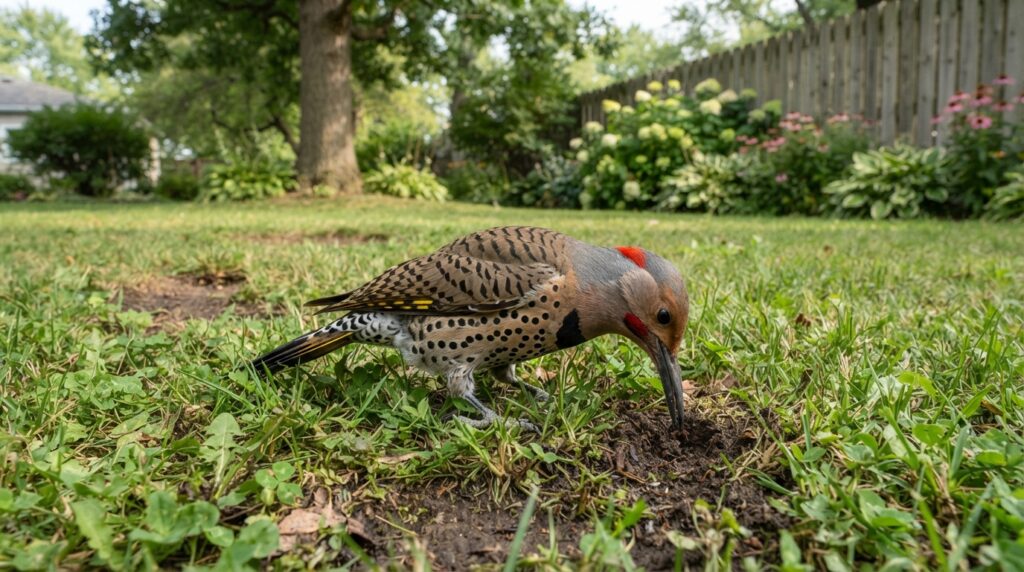
A large, brown, black-spotted bird with a black bib, probing your lawn with a long bill, is a Northern Flicker. It’s a woodpecker, but ants are its main food, so it spends much of its time on the ground digging them out with a long, barbed tongue. It’s not hurting your lawn. If anything it’s eating grubs and other insects. When it flies off, look for the flash of white on its rump and yellow or salmon-red under the wings.
Most people don’t expect to see a woodpecker walking across the grass. The flicker breaks the rules: it’s the size of a small pigeon, it hops around on the ground like a robin, and it pokes its bill into the soil over and over in the same spot.
Audubon describes it as probably eating ants more often than any other North American bird. That’s what it’s doing in your yard.
The essentials
- A woodpecker that feeds mostly on the ground
- Main food: ants, plus beetle larvae
- Not a lawn pest
- In flight: white rump, yellow or red flashes
- Two forms: Yellow-shafted (East) and Red-shafted (West)
- Declining: down about 49% since 1966
How to identify a flicker
All About Birds gives its size as 11 to 12.2 inches long and 3.9 to 5.6 ounces. That’s bigger than a robin, and far bigger than the Downy and Hairy Woodpeckers at your suet.
- Back: brown with black bars
- Front: buff with round black spots, and a black crescent bib across the breast
- Rump: bright white, obvious as it flies away
- Under the wings and tail: yellow in the East, salmon-red in the West
- Flight: strongly up-and-down, like other woodpeckers
Yellow-shafted or Red-shafted?
There are two main forms, once considered separate species. According to All About Birds:
| Yellow-shafted | Red-shafted | |
|---|---|---|
| Where | East and North | West |
| Wing and tail linings | Yellow | Salmon-red |
| Face | Tan face, gray crown | Gray face, brown crown |
| Nape | Red crescent on the back of the head | No red crescent |
| Male’s “mustache” | Black | Red |
Females of both forms lack the mustache stripe. Where the two meet, in a long, narrow zone through the Great Plains that All About Birds traces from Alaska to the Texas panhandle, they interbreed, and you can see birds with mixed features, such as orange wing linings or one red and one black mustache.
Why it’s digging in your lawn
All About Birds says ants are the flicker’s main food. It digs into the soil and uses its long, barbed tongue to lap them up. The tongue can reach about 2 inches beyond the tip of the bill.
- In one study in British Columbia summarized by Birds of the World, about 98% of food items were ants
- A Washington Department of Fish and Wildlife publication cites an Oregon biologist who found more than 2,000 ants in a single flicker’s stomach
- Flickers also eat beetles and other insects, and in fall and winter add berries and seeds, including poison ivy, dogwood, sumac, cherry and grape
Is it damaging the lawn?
No. University of Maryland Extension says birds digging in lawns need no management, because they’re eating lawn insects that can be pests, such as beetle grubs and armyworm caterpillars. If a patch looks rough, it recommends overseeding bare spots. The small holes a flicker leaves close up quickly.
Most of the time, a flicker in your lawn is simply a sign you have a healthy ant population, which is normal and not a problem.
What’s “anting”?
Sometimes a flicker, or another bird, will sit on an ant mound with wings spread, or pick up ants and rub them through its feathers. All About Birds describes flickers smearing ants over their feathers deliberately. Nobody knows for sure why. Audubon notes it may help control feather parasites. More on sunning and anting.
Do flickers come to feeders?
Not often. All About Birds notes they don’t regularly visit feeders, though the Washington Department of Fish and Wildlife says they’re attracted to suet, particularly in winter. A suet feeder with a tail prop, hung near trees, gives you the best chance. How to attract woodpeckers.
The better way to support flickers is to leave some ant habitat: avoid blanket insecticide treatments on the lawn, and leave a few bare, sunny patches and dead wood around the yard.
Migration
All About Birds calls the flicker one of the few strongly migratory North American woodpeckers. Audubon notes northern Yellow-shafted birds from Alaska and Canada are strongly migratory, while Red-shafted birds move shorter distances.
Drumming on the chimney
Flickers are loud drummers. In spring, a male will hammer on the loudest surface he can find, including metal gutters, downspouts, chimney caps and vents. All About Birds records a flicker in Wyoming drumming on a tractor that could be heard half a mile away. The Washington Department of Fish and Wildlife says breeding-season drumming runs from mid-March to June, and usually doesn’t go through wood siding.
If a flicker is drilling holes in the house rather than drumming, see woodpecker pecking holes in your house.
Nest boxes for flickers
Flickers nest in cavities they dig in dead or soft wood. All About Birds gives a clutch of 5 to 8 eggs, incubation of 11 to 13 days and a nestling period of 24 to 27 days. Unlike most woodpeckers, they’ll use a nest box, if it’s set up the way they like.
NestWatch’s specifications for a flicker box:
- Entrance hole: 2½ inches
- Floor: 7¼ x 7¼ inches
- Interior depth: 24 inches
- Mount 6 to 12 feet high, on a baffled pole at least 10 feet from trees
- Pack it to the top with wood chips (NestWatch specifies white pine), and replace them by April 1 each year. Flickers want to excavate, and will dig out the chips
NestWatch warns that European Starlings may take over flicker boxes. Monitor it and remove starling nests, which aren’t protected.
A ready-made flicker box saves building a deep, heavy box yourself. Honest drawbacks: check the listing against NestWatch’s measurements, since some “woodpecker houses” are far too shallow; boxes need filling with chips every spring or flickers ignore them; starlings compete for them; and a box this size is heavy to mount. Building from NestWatch’s free plan is a good weekend project if you have the tools.
How they’re doing
Flickers are still common, but they’re declining. All About Birds reports a decline of about 1.2% a year from 1966 to 2021, a cumulative drop of 49%, based on the North American Breeding Bird Survey. Partners in Flight estimates a global breeding population of 12 million and rates the species Low Concern.
Common questions
Why is a woodpecker on the ground?
It’s probably a Northern Flicker eating ants. Flickers feed on the ground more than any other North American woodpecker.
Are flickers bad for my lawn?
No. University of Maryland Extension says birds digging in lawns need no management and are eating insects, including grubs. Overseed any bare patches.
What’s the difference between yellow-shafted and red-shafted flickers?
Yellow-shafted birds, in the East, have yellow wing linings and a red nape crescent. Red-shafted birds, in the West, have salmon-red linings and no crescent. Males’ mustache stripes are black and red respectively.
Do flickers eat suet?
Sometimes, especially in winter, but they don’t visit feeders regularly. Ants are their main food.
What is the white patch on a flicker’s back?
Its rump. It flashes white as the bird flies away and is one of the easiest ways to identify it.
Will flickers use a birdhouse?
Yes, if it’s deep enough and packed with wood chips for them to dig out. NestWatch recommends a 2½-inch hole and 24-inch depth.
Related guides
- How to attract woodpeckers
- Woodpecker pecking holes in your house
- Why is that bird lying on the ground with its wings spread?
- Nest box hole sizes by species
Sources: Cornell Lab of Ornithology, All About Birds, Northern Flicker overview, identification and life history; Cornell Lab, Birds of the World, Northern Flicker food habits; Cornell Lab, NestWatch Northern Flicker nest box page; National Audubon Society, Northern Flicker field guide and “10 Fun Facts About the Northern Flicker”; Washington Department of Fish and Wildlife, Living with Wildlife: woodpeckers; University of Maryland Extension, Animals digging in lawns; Utah State University Extension; Partners in Flight and the North American Breeding Bird Survey, via All About Birds.
Want a closer look?
A pair of 8x42 binoculars is the single thing that changes backyard birding most. Close focus matters more than magnification when the bird is fifteen feet away.
This link goes to Amazon. If you buy through it we may earn a small commission, at no extra cost to you.