
Affiliate disclosure: some links on this page go to Amazon. If you buy through one we may earn a small commission, at no extra cost to you. Full disclosure.
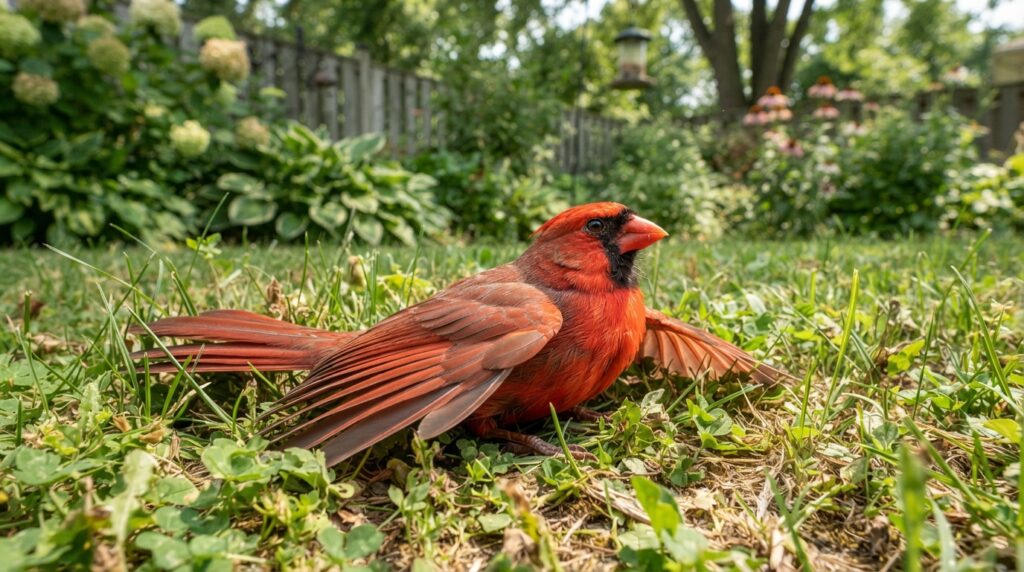
It is almost certainly sunning. Birds deliberately sprawl in direct sun with wings and tail fanned, feathers raised and beak open, often looking glassy-eyed and unresponsive. It is normal and probably helps with feather maintenance and parasites. The giveaway is that a sunning bird flies off normally the moment something startles it — a sick one does not.
This is one of the most alarming normal behaviors a backyard bird performs. A robin or a cardinal drops onto the lawn, flattens itself, fans one wing out at an odd angle, tips its head sideways with its beak open, and stops moving. It looks like a bird that has been hit by something.
Wildlife rehabilitators get calls about it constantly, particularly on the first properly hot days of summer.
What sunning looks like
- Flat on the ground, breast down, often on a hard warm surface
- Wings and tail fanned, sometimes just one wing, sometimes asymmetrically
- Feathers raised so sun reaches the skin
- Beak open, head tilted to one side
- Eyes half closed, apparently oblivious
- Flies off normally when disturbed — this is the important part
Why birds do it
Sunning is well documented across a wide range of species, and the reasons are not fully settled. Several explanations are plausible and probably all contribute:
Feather maintenance. Heat makes preen oil more fluid and easier to spread through the plumage. Many birds sun and then preen immediately afterward, which fits this neatly.
Parasite control. Heat drives feather mites and lice out of their preferred spots and into the open, where the bird can reach them when it preens. Birds often sun most intensively in summer, when parasite loads peak.
Vitamin D. Sunlight acting on preen oil is thought to contribute to vitamin D production, which the bird then ingests while preening. This is a long-standing hypothesis rather than a settled fact.
Feather straightening. Heat may help realign feather barbs after molt, when new feathers are still settling.
Worth knowing: sunning happens on hot days, not cold ones. A bird flattening itself on a 95°F patio is not warming up — it is doing something to its feathers, and the position it adopts is the same one used to shed heat, which is why it also looks like heat distress.
Anting: the stranger one
Occasionally you will see something more peculiar: a bird sitting on an ant nest, letting ants swarm over it, or picking up individual ants and deliberately rubbing them through its plumage.
This is called anting, and it is well documented in over two hundred species worldwide. Blue Jays are among the more reliable performers in American backyards, along with grackles, starlings, robins and crows.
The two forms:
- Active anting — the bird picks up ants in its bill and wipes them along the feathers, especially under the wings
- Passive anting — the bird sits on the nest, wings spread, and lets ants climb over it
The leading explanation is that formic acid sprayed by the ants acts against feather mites, lice and possibly fungi and bacteria. Supporting this, birds preferentially use ant species that produce formic acid and generally avoid stinging ants. Some birds have been recorded using other pungent substances the same way — millipedes, citrus peel, even cigarette butts.
Other explanations have been proposed, including that anting prepares the ants for eating by draining the acid, or that it simply feels good. None is conclusively established. It is one of the more genuinely unexplained common behaviors in ornithology, which is part of what makes seeing it worthwhile.
Telling sunning from a bird in trouble
This is the practical question, and there is a reliable test.
| Sunning | Needs help | |
|---|---|---|
| When disturbed | Flies off normally, often reluctantly | Cannot fly, or flutters and fails |
| Posture | Deliberate — wings fanned, feathers raised | Slumped, wings drooping rather than spread |
| Location | Open sun, warm surface, often the same spot repeatedly | Anywhere, often below a window |
| Eyes | Half closed, relaxed | Closed, crusted or swollen |
| Duration | Minutes, then preens and leaves | Stays put, sometimes hours |
| Weather | Sunny and warm | Any |
Approach quietly and see what happens. A sunning bird will get up and go. If it does not, look for other signs.
Treat it as an injury or illness if the bird: cannot fly, has a drooping wing, has swollen or crusted eyes, is bleeding, has been near a window, or has had any contact with a cat. Contact a licensed wildlife rehabilitator — a cat’s mouth carries bacteria that will kill a bird within days even from punctures too small to see.
If several birds in the yard look unwell, treat it as a disease question instead: take feeders and baths down for one to two weeks and disinfect. What to look for.
Encouraging it in your yard
Sunning and anting are not things you can arrange, but you can make a yard where they happen where you can see them.
- Leave a patch of open sunny ground — bare soil, gravel, a flagstone or a warm path
- Do not treat ant nests in lawn areas away from the house. Ants are food and, apparently, grooming equipment
- Avoid pesticides generally. Insecticides remove the invertebrates birds feed on and feed to their young
- Provide water nearby. Birds often bathe, then sun, then preen, in sequence
A shallow bath placed near an open sunny patch is the setup that produces the bathe-sun-preen sequence where you can watch it. Depth is what matters — under two inches at the edge, no more than three in the middle, with a textured base for grip. Honest drawbacks: baths need scrubbing at least weekly in warm weather, concrete ones crack if left full through a freeze, and most decorative baths are sold too deep and too smooth to be usable by small birds without a couple of flat stones added.
Common questions
Is a bird lying flat with its wings out hurt?
Usually not. Sunning looks exactly like injury but is deliberate. The test is whether it flies off normally when you approach — a sunning bird will.
Why does a sunning bird hold its beak open?
Partly heat. Birds cannot sweat, so an open beak and fluttering throat shed heat, and a bird deliberately lying in full sun gets hot. It is part of the same posture.
What is anting?
A bird deliberately rubbing ants through its feathers, or sitting on an ant nest and letting them swarm over it. Formic acid appears to act against feather parasites, though the behavior is not fully explained.
Which birds ant?
Over two hundred species worldwide. In American backyards Blue Jays are the most likely, along with grackles, starlings, robins and crows.
Should I move a sunning bird out of the open?
No. It chose that spot deliberately, and handling a wild bird causes stress and is unlawful for most native species without a permit. Keep cats indoors instead.
Do birds sunbathe in winter?
They do sun themselves in cold weather to gain warmth, but the flat, fanned, beak-open posture is mainly a hot-weather behavior tied to feather maintenance.
Related guides
Sources: Cornell Lab of Ornithology, All About Birds and Birds of the World, on sunning and anting behavior; National Audubon Society; published research on anting and formic acid in feather parasite control; state wildlife agency and licensed wildlife rehabilitation guidance on distinguishing normal behavior from injury.
Want a closer look?
A pair of 8x42 binoculars is the single thing that changes backyard birding most. Close focus matters more than magnification when the bird is fifteen feet away.
This link goes to Amazon. If you buy through it we may earn a small commission, at no extra cost to you.